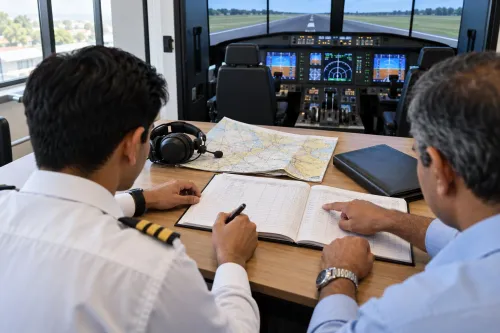

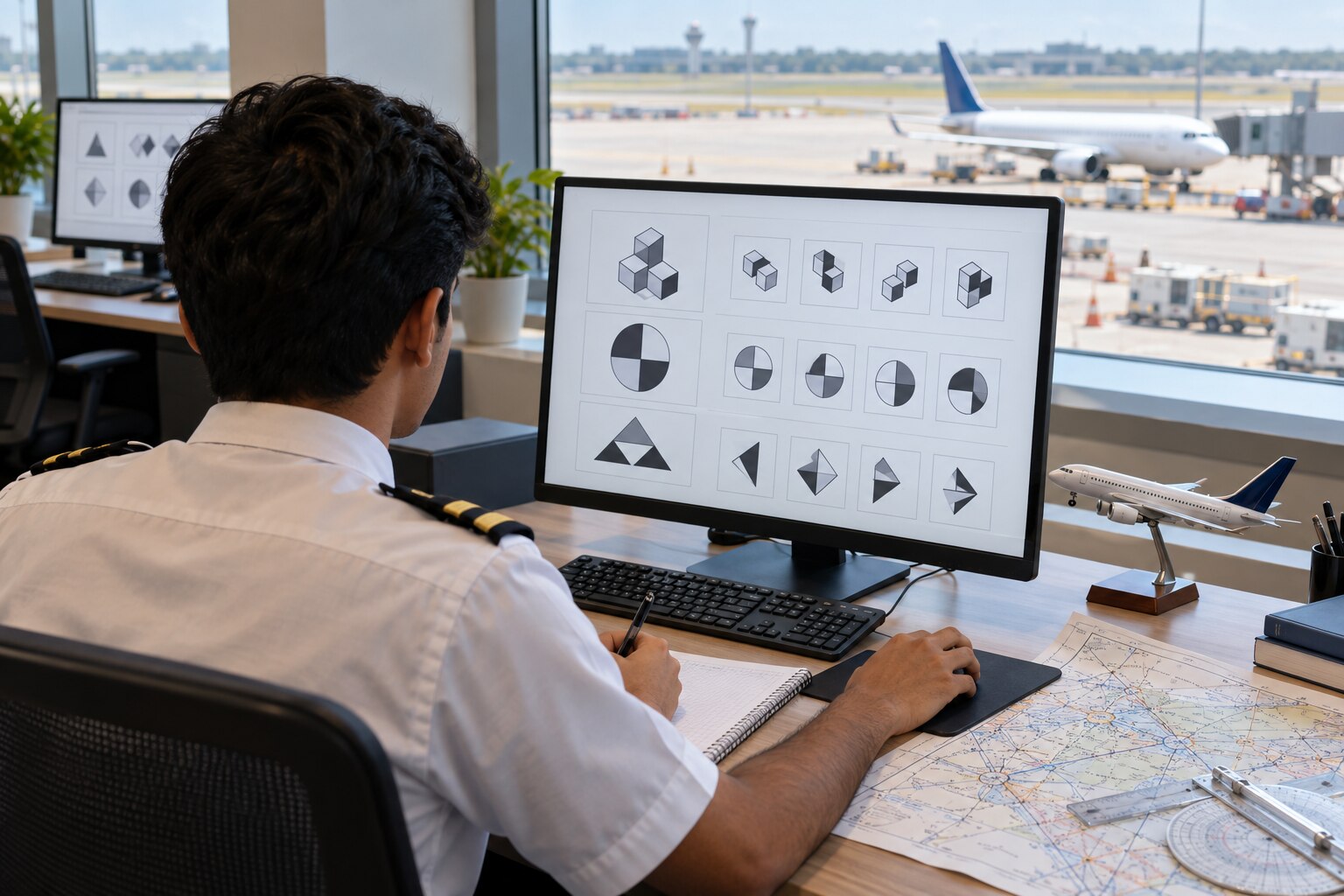
Airline and cadet-programme selection can combine academic tests, timed aptitude, psychometric screening, group tasks, simulator assessment and interviews, so DGCA theory study alone leaves important gaps. You will be able to build a preparation timeline, verify your eligibility and documents, measure weak areas, choose suitable support and arrive at the exam with a practical final-week plan.
Key takeaways
- Confirm programme eligibility and medical requirements before paying for training.
- Map preparation to every selection stage, not only the written exam.
- Use timed mocks to identify weak subjects and improve score speed.
- Apply only after checking documents, medical status and application deadlines.
Start with the programme rules, eligibility and a diagnostic test
Before paying for coaching or flight training, confirm that you can enter the programme and complete its medical requirements. Passing an airline entrance exam does not itself produce a Commercial Pilot Licence: licensing also involves education, age, medical fitness, flight experience, skill tests and DGCA requirements.
Use this order to find the real preparation target:
1. Download the latest airline or cadet-programme notice and record its age limit, Class 10 and 12 requirements, Mathematics and Physics rules, nationality or passport conditions, English standard, application deadline, test format, fees and selection stages. This is the programme rules, not a generic pilot checklist.
2. Match each requirement against your documents and medical position. Arrange a Class 2 medical assessment early through the DGCA-approved process to identify remediable problems, then confirm the Class 1 medical pathway required for CPL issuance before committing substantial training money.
3. Request the exact airline entrance exam syllabus and build a diagnostic test from it. Include numerical ability, Physics, reasoning, English, spatial awareness, aviation awareness and any technical or psychometric sections. Mark every question by topic, time used and error type.
Your results show what to prepare first. A weak wind-triangle score needs Air Navigation practice, while unfamiliar aircraft systems require Technical General study. Prepare Technical Specific only from the aircraft type’s current Pilot Operating Handbook, Aircraft Flight Manual, checklists and training material; use current Indian regulatory sources for Air Regulations, not foreign question banks alone.
Build a realistic timeline around the actual selection stages
Allocate 10 to 12 weeks for an airline entrance exam preparation timeline if you are starting from average school-level knowledge. Use the first weeks to build speed, the middle weeks for technical and aviation study, and the final weeks for selection-stage practice.
1. Weeks 1–2: Take timed diagnostics in numerical ability, physics, English and the reasoning test. Record accuracy and completion time, then divide study hours according to your weakest scores rather than giving every subject equal attention.
2. Weeks 3–6: Practise mathematics, physics, spatial awareness and reasoning under time limits. Add daily English work covering grammar, reading comprehension and vocabulary. Study aviation awareness alongside these subjects, using current official sources for operational information.
3. Weeks 5–8: Prepare Technical General as a broad study of aircraft systems and operating principles. Prepare Technical Specific only from the aircraft type’s current approved Pilot Operating Handbook, Aircraft Flight Manual, checklists and training material; generic notes cannot replace those documents.
4. Weeks 8–10: Begin full-length mocks and complete psychometric test practice. Do not try to memorise personality answers; keep responses consistent, read instructions carefully and practise working accurately under fatigue.
5. Weeks 10–12: Rehearse the simulator assessment and interview. For the simulator, practise scan, prioritisation and following instructions rather than chasing perfect handling. For the interview, prepare clear evidence for your motivation, training choices, setbacks and knowledge of the programme.
Keep one weekly half-day for reviewing errors and updating your plan. If the programme includes group exercises, add them before the interview stage. Confirm the published stage order before booking travel or medical appointments.
Strengthen the subjects that decide your timed-test score
Timed scores improve when you practise the task that produces the marks, not when you reread another chapter. Build short, timed sets after learning each concept, then label every error as a knowledge gap, formula mistake, unit conversion, misread question or time pressure.
- Use aviation mathematics for time-speed-distance, fuel, endurance and weight calculations. Repeat problems until you can select the correct formula without searching your notes.
- Practise aviation physics through force, pressure, energy, lift, drag and basic aircraft-performance questions. Explain why the answer is correct; memorised equations collapse when the wording changes.
- Drill unit conversion and trigonometry separately, then combine them in navigation problems involving wind triangles, headings, tracks and dead reckoning.
- Read Air Regulations, Air Navigation, Aviation Meteorology and Technical General from current Indian material. Foreign question banks can teach the wrong licensing rules, documents or terminology.
- Treat aviation English as a timed skill. Build aviation vocabulary, read weather reports and operational passages aloud, and increase reading speed without sacrificing figures, negatives or conditions.
| Skill | Deliberate practice | Failure it exposes |
|---|---|---|
| Aviation mathematics | 10–15 timed problems, followed by error classification | Formula selection or arithmetic weakness |
| Aviation English | Timed passages with a one-line answer rationale | Slow reading or missed wording |
| Navigation | Wind triangles, chart interpretation and position-fixing sets | Weak trigonometry, conversion or procedure |
| Technical knowledge | Mixed aircraft-systems questions under a countdown | Recognition without usable recall |
Finish each study session by rewriting the method for every wrong answer. Repeating untimed questions hides the exact skill that costs you marks.
Use mocks, coaching and interview practice as separate preparation tools
Take one timed airline mock test each week, then increase to two during the final fortnight. Follow the published time limit and apply negative marking; guessing strategies that work on one test can reduce your score on another.
A mock is useful only after review. Record every wrong or guessed question under one cause:
- Knowledge gap
- Formula or unit-conversion error
- Misread wording
- Time pressure
- Careless calculation
Revisit the matching topic with spaced revision, then retake only the missed question type. Keep mocks separate from interview preparation: practise a mock interview aloud, and rehearse concise answers about training choices, safety decisions and setbacks. Prepare for a group exercise by contributing clearly, listening, and disagreeing without interrupting.
Choose your study method from the problem you have, not from fashion.
| Option | What it means | When it applies |
|---|---|---|
| Self-study | You plan topics, source current material and audit your own errors | Use it when your diagnostic scores are stable and you can maintain a weekly schedule |
| Coaching | An instructor explains difficult concepts, sets timed work and challenges weak areas | Choose it when errors persist in navigation, meteorology, technical subjects or test strategy |
| Hybrid | You study independently and use scheduled instruction for correction and accountability | Best when you need structure without surrendering control of your preparation |
For DGCA ground school, SKYJET PILOT TRAINING ACADEMY is worth comparing on whether feedback covers separate papers, current operational references and your error log—not merely the number of classroom hours.
Related products
 | DGCA - Ground School Air Regulation Course Air Regulation Course in India – DGCA CPL Training at Skyjet Pilot Training Academy At Skyjet Pilot Training Academy, the Air Regulation course in... |
 | DGCA Approved Flying School Pilot Training in Indian Flying school (DGCA CPL) While training abroad offers speed, pursuing a Commercial Pilot License (CPL) through an Indian flying club or Flight Training Organisation (FTO)... |
Choose your application timing and complete the final checks
Make the airline application decision after checking eligibility, medical status, documents and the programme deadline—not simply when your study notes are complete. Arrange the DGCA-approved aviation medical process before committing substantial training money: Class 2 can reveal problems early, while Class 1 is relevant to CPL issuance.
Include medical costs in your budget alongside coaching fees, examination charges and travel.
| Application timing | Advantage | Risk |
|---|---|---|
| Immediately after eligibility and medical checks | Secures your place and gives you a fixed deadline | You may enter before reaching your target mock score |
| After a diagnostic score and structured revision | Matches application timing to measurable readiness | Waiting too long can leave insufficient time for documents or retesting |
| Close to the deadline | Preserves study time if the programme permits late application | A missing certificate, payment failure or medical issue can end the attempt |
Set aside a defined block of study hours rather than studying whenever time appears. Use the final seven days for timed practice, sleep, travel planning and the pre-exam checklist, not new chapters.
If you have an unsuccessful attempt, record the stage, score, time loss and interview feedback within 24 hours. Check the next eligibility date, ask whether scores or documents remain valid, and rebuild the weakest section before paying another application fee.
- Recheck identity proof, certificates, marksheets, medical records, photographs and payment confirmation.
- Keep a document backup in two cloud locations and one offline folder.
- Confirm the test centre, reporting time, permitted calculator and required originals.
Frequently asked questions
What should you check before starting airline entrance exam preparation?
Check the programme’s eligibility rules and medical requirements, then take a diagnostic test before paying for coaching or flight training.
How should you build a timeline for an airline entrance exam?
Work backwards from the application deadline and schedule separate preparation for each selection stage, including timed tests, interviews and final checks.
Which subjects should you prioritise for the timed test?
Use your diagnostic results and mock scores to prioritise subjects that reduce your accuracy or speed under exam conditions.
How should you use mocks, coaching and interview practice?
Treat them as separate tools: use mocks for timing and score analysis, coaching for difficult concepts, and interview practice for communication and selection readiness.
Related products
 | DGCA - Ground School Air Navigation SkyJet Pilot Training Academy – Air Navigation Preparation for DGCA CPL SkyJet Pilot Training Academy is a trusted name for DGCA CPL Ground Classes... |
 | DGCA - Ground School Aviation Meteorology Classes Aviation Meteorology Classes for DGCA CPL – Complete Training Guide At Skyjet Pilot Training Academy, Aviation Meteorology is not just a subject—it... |
 | DGCA - Ground School DGCA Technical Specific Cessna 172R DGCA Technical Specific Course | Complete POH & AFM Preparation Master the DGCA Technical Specific Examination for the Cessna 172R with a... |
 | DGCA - Ground School Technical General DGCA CPL Technical General: Complete Guide to Aircraft Systems & Aerodynamics Technical General is one of the most important and conceptually... |