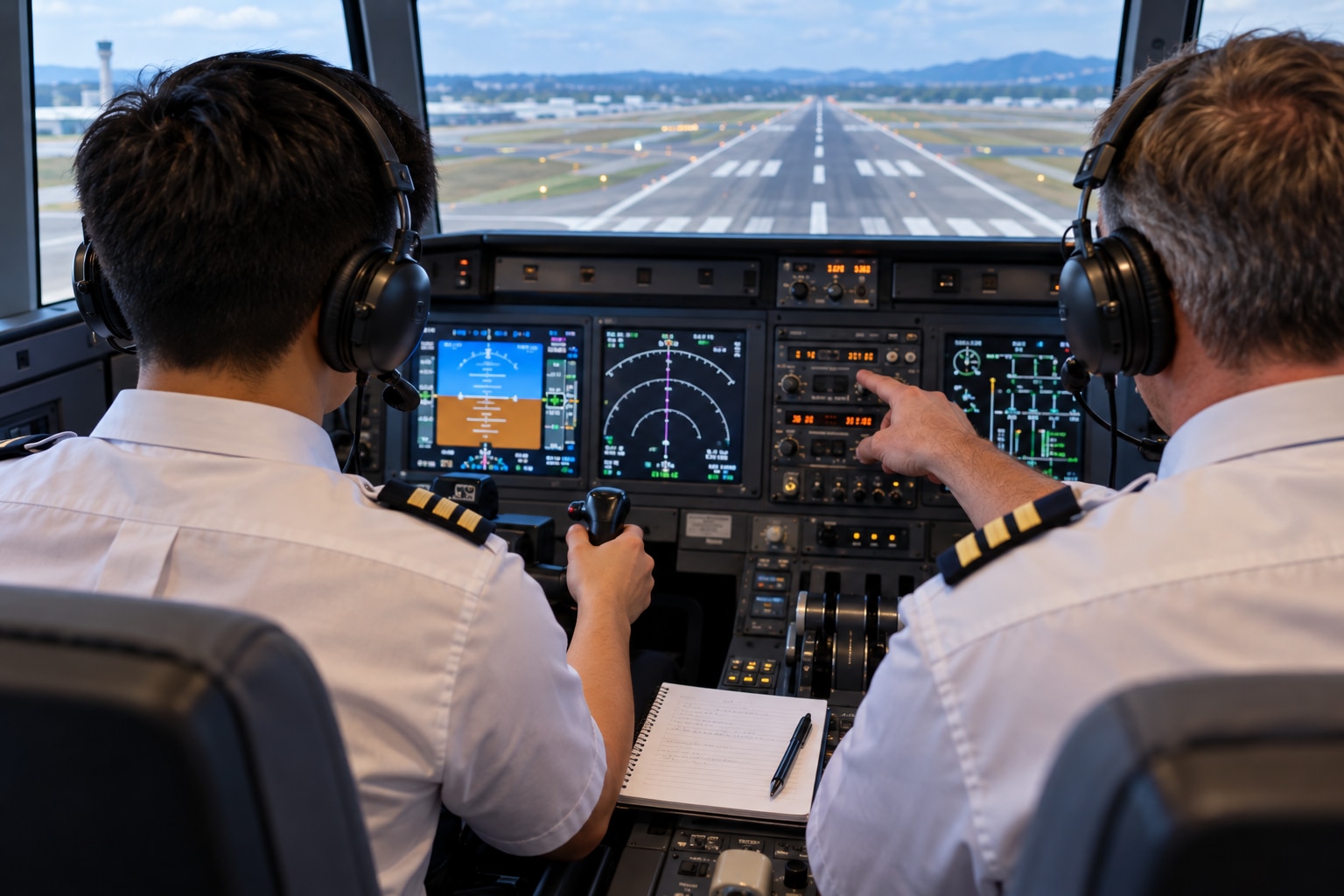
A pilot can know aviation theory and still create risk by mishearing a heading, missing a negation, or giving an incomplete readback. By the end, you will understand what Aviation English demands in real cockpit communication, how ICAO measures it, and which training habits improve safe performance on the radio.
Key takeaways
- Use standard phraseology for clearances, headings, altitudes and runway designators.
- Switch to plain English when an abnormal situation has no standard phrase.
- Target ICAO operational proficiency, not only grammar or conversational fluency.
- Practise readbacks, listening and concise radio calls for the Indian CPL pathway.
What Aviation English Requires Beyond Ordinary English
Aviation English means using English to make flight operations safe, not simply speaking English correctly. It combines standard phraseology—callsigns, headings, altitudes, runway designators and clearance readbacks—with plain English when an abnormal or unexpected situation does not fit a standard phrase.
Aviation communication skills also cover intelligible pronunciation, listening for numbers and restrictions, concise cockpit language, and asking for clarification instead of guessing.
| Type of English | What it demonstrates | What it does not guarantee |
|---|---|---|
| Conversational English | Everyday interaction and informal explanations | Accurate readbacks during radio work |
| School-level English | Grammar, reading, writing and general vocabulary | Understanding clipped transmissions under workload |
| Examination English | Knowledge shown in written or oral answers | Real-time coordination with ATC and crew |
| RTR (A) English | Radio-telephony knowledge and the operator pathway | Complete operational language proficiency |
RTR (A) relates to aeronautical radio use; it does not replace broader language ability. Indian CPL candidates must check current DGCA Civil Aviation Requirements and Indian radio-telephony arrangements rather than rely on an old coaching note. ICAO Operational Level 4 is the minimum for pilots and controllers using radiotelephony.
It demands intelligibility, not a native accent.
| ICAO assessment area | Practical requirement |
|---|---|
| Pronunciation | Speech remains understandable over radio equipment |
| Structure | Grammar supports clear meaning |
| Vocabulary | You describe routine and unfamiliar situations |
| Fluency | You speak without disruptive pauses |
| Comprehension | You extract numbers, restrictions and intent |
| Interactions | You respond, correct, clarify and manage the exchange |
How English Connects Everyone in Flight Operations
English is the international aviation language because aircraft cross borders where pilots and controllers may not share a first language. A common language gives everyone a predictable method for clearances, warnings and coordination.
ICAO sets Operational Level 4 as the minimum proficiency for pilots and controllers using radiotelephony; it measures safe communication, not a native-sounding accent.
During normal operations, pilots use English for:
- Clearance readbacks: confirm the route, runway, altitude, heading and transponder code so the controller can catch an error before it becomes a deviation.
- Taxi and take-off: understand holding points, runway instructions, line-up clearance and immediate changes from ground or tower control.
- Approach and landing: manage frequency changes, position reports, approach clearances, missed-approach instructions and runway occupancy information.
- Cockpit communication: coordinate tasks, checklists, weather decisions and changes between the pilot flying and pilot monitoring.
- Cabin crew communication: exchange information about turbulence, medical events, passenger issues and preparation for landing.
- Flight operations support: understand instructions and technical information from dispatch, maintenance and other operational staff.
Unexpected events require more than memorised phrases. Standard phraseology handles routine calls, but pilots need plain English to describe smoke, system failures, conflicting instructions or uncertainty. That exchange may involve unfamiliar accents, rapid speech or a second-language speaker, so training with one carefully paced voice leaves a serious gap.
Clear listening and concise speaking protect pilot-controller communication when the plan changes.
How ICAO Measures Operational Language Proficiency
The ICAO Language Proficiency Rating Scale measures whether you can communicate safely in operational situations, not whether you can write flawless English or sound like a native speaker. Testing covers speaking and listening during routine exchanges, unexpected developments, and misunderstandings.
It assesses six separate areas:
- Pronunciation: how clearly you produce sounds and words
- Structure: whether your grammar supports accurate meaning
- Vocabulary: whether you can describe routine and non-routine situations
- Fluency: how smoothly and promptly you communicate
- Comprehension: how accurately you understand spoken messages
- Interactions: how you initiate exchanges, respond, confirm information, and resolve confusion
You must meet the required standard across the scale; strength in one area cannot cancel a serious weakness in another.
ICAO Level 4, called Operational Level, is the minimum for pilots and air traffic controllers who use radiotelephony. It means you can understand and deliver clear messages under radio conditions, handle unexpected information, and repair a misunderstanding instead of staying silent or pretending to understand.
A noticeable Indian, British, American, or other first-language accent is acceptable when pronunciation rarely interferes with understanding. The target is intelligibility, not accent removal.
A written grammar result alone does not prove operational ability. Level 4 assessments commonly require reassessment every three years; Level 5 commonly uses a six-year interval, while Level 6 is expert. Follow your licensing authority’s current procedure.
Why Short Radio Errors Can Become Flight-Safety Errors
A single missed “not” or transposed digit can change a clearance from safe to unsafe. Misheard numbers, similar-sounding letters, clipped transmissions and incomplete readbacks can send an aircraft toward the wrong runway, altitude, heading or route. Radio compression, background noise, unfamiliar accents and fast speech make short instructions harder to decode than their grammar suggests.
| Mistake | Operational risk | Corrective habit |
|---|---|---|
| Similar-sounding numbers or letters | Wrong altitude, heading, callsign or route entry | Write the instruction before transmitting |
| Partial readback | The controller cannot detect the missing restriction | Repeat every safety-critical item |
| Missed negation or condition | You act on a clearance that was cancelled or limited | Listen for “not,” “unable,” “hold short” and “except” |
| Unclear frequency changes and squawk codes | You contact the wrong frequency or become difficult to identify | Read both items back and verify the digits |
Deliver a clear readback in a fixed order:
- Confirm the callsign, then repeat runway designators, headings and altitudes, route limits, frequency changes and squawk codes exactly as received.
- Use standard phraseology, speak at a measured pace and separate numbers clearly. Do not replace an uncertain word with a guess.
- Compare the clearance with your flight plan and instruments. If anything conflicts or sounds incomplete, say “Say again” or ask the controller to clarify before acting.
- Report an unusual situation in plain English when standard phraseology cannot express it. Accurate readback is a safety check, not a formality.
How to Build Aviation English for the Indian CPL Pathway
Treat English as a flight skill and a licensing task, not a vocabulary subject. For DGCA CPL preparation, check the current DGCA Civil Aviation Requirements, examination notices and Indian radio-telephony requirements instead of relying on an old coaching note.
1. Listen to complete clearances from different accents and speaking rates. Write down runway numbers, headings, altitudes, frequencies, squawk codes and restrictions without replaying the recording.
2. Speak concise position reports, weather requests, frequency changes and abnormal-situation calls. Record yourself and correct pronunciation, pace and unnecessary words.
3. Practise radio telephony communication as an exchange: receive a clearance, read it back accurately, identify an error, correct your readback and ask for clarification when a detail is unclear.
4. Add workload. Handle a taxi instruction while reading a chart, or respond to an unexpected routing change while retaining the relevant numbers and constraints.
5. Review every exercise under the six ICAO language areas: pronunciation, structure, vocabulary, fluency, comprehension and interactions.
Operational Level 4 is the minimum ICAO language-proficiency level for pilots using radiotelephony. You do not need a native accent; you do need communication that remains clear and effective when the situation changes. Strong written grammar cannot compensate for weak listening or interaction.
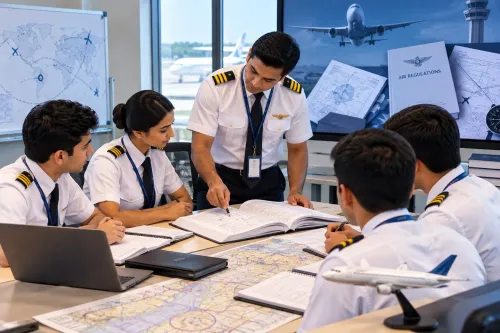
When comparing Indian pilot training providers, ask whether the programme uses recorded multi-accent exchanges and live correction rather than only scripted drills. SKYJET PILOT TRAINING ACADEMY can make its ground-school scenarios useful by linking Air Regulations and navigation exercises to aviation English practice, clearances and cockpit decisions.
Related product
 | DGCA - Ground School Radio Telephony Course RTR (A) RTR (A) – Radio Telephony Course in Pune SKYJET PILOT TRAINING ACADEMY, Pune Master Aviation Communication. Clear RTR in First Attempt. |
Frequently asked questions
What does aviation English require beyond ordinary English?
It requires accurate standard phraseology for routine operations and clear plain English when unexpected situations do not fit a standard phrase.
How does English connect everyone in flight operations?
Aviation English gives pilots, air traffic controllers and other flight operators a shared language for clearances, coordination and safety-critical information.
How does ICAO measure aviation English proficiency?
ICAO assesses pronunciation, structure, vocabulary, fluency, comprehension and interactions on a six-level language proficiency scale.
Why can a short radio error become a flight-safety error?
A wrong callsign, heading, altitude, runway designator or readback can cause a pilot to misunderstand a clearance or act on incorrect information.
How can you build aviation English for the Indian CPL pathway?
Practise listening to aviation transmissions, standard phraseology, clearance readbacks, plain-English explanations and concise radio calls alongside DGCA ground-school preparation.