
A pilot aptitude assessment tests how you calculate, concentrate, orient yourself and respond under pressure—not just how much aviation theory you remember. By following a timed practice plan, reviewing errors by type and checking the organiser’s scoring rules, you can prepare for the specific battery instead of guessing at a generic syllabus.
Key takeaways
- Identify the airline or school test battery before choosing practice exercises.
- Practise mental arithmetic, estimation and spatial rotation without a calculator.
- Train tracking, memory and multitasking together under strict time limits.
- Review errors by skill, speed and accuracy before changing your practice plan.
Identify the Test You Are Actually Taking
A pilot aptitude test measures how you process information and control tasks, not simply how much aviation theory you remember. A battery may test numerical reasoning, spatial orientation, attention, memory, reaction speed, hand-eye coordination, multitasking, English comprehension and decisions under time pressure. Strong DGCA theory knowledge does not guarantee accurate tracking or divided-attention performance.
| Assessment | What it measures | What it does not establish |
|---|---|---|
| DGCA written examination | Knowledge of air regulations, air navigation, meteorology, and aircraft and engines | Your coordination, reaction speed, or suitability for a particular airline |
| Airline cadet assessment | A selection process that may combine aptitude tests, interviews, group tasks, simulator exercises, and medical screening | A single standard syllabus or pass mark across airlines |
| Psychometric test | Standardised measurement of abilities, traits, or responses; a pilot aptitude battery is one possible form | A pilot licence or DGCA examination pass |
| Flight-school admission test | The school’s chosen screening of basic maths, English, reasoning, or readiness | That every other school will use the same format |
There is no single DGCA-wide pilot aptitude test. Ask the organisation conducting yours for the test provider, sections, time limits, permitted equipment, scoring method, retake policy, and any minimum scores. Treat English screening separately from ICAO operational language requirements; passing one does not automatically establish every licence or radio qualification.
Know the Tasks, Timing and Scoring Before You Practise
Expect separate tasks, not one long aviation quiz. A flight school, airline or assessment provider sets the battery, so there is no single DGCA-wide aptitude syllabus, time limit or pass mark. Questions may be multiple-choice, matching, rapid-response or continuous tracking, with each section timed separately.
| Task | Typical format | What the score reflects |
|---|---|---|
| Numerical reasoning | Read a table or graph, then solve ratios, percentages, rates or time–speed–distance questions | Correct answers under a short limit |
| Mental arithmetic | Add, subtract, multiply, divide or estimate without a calculator | Accuracy and response speed |
| Spatial orientation | Rotate an aircraft, follow a heading, identify relative bearings or track a changing viewpoint | Three-dimensional awareness and left–right control |
| Mechanical reasoning | Predict how gears, levers, pulleys or forces will move | Basic physical principles, not aircraft trivia |
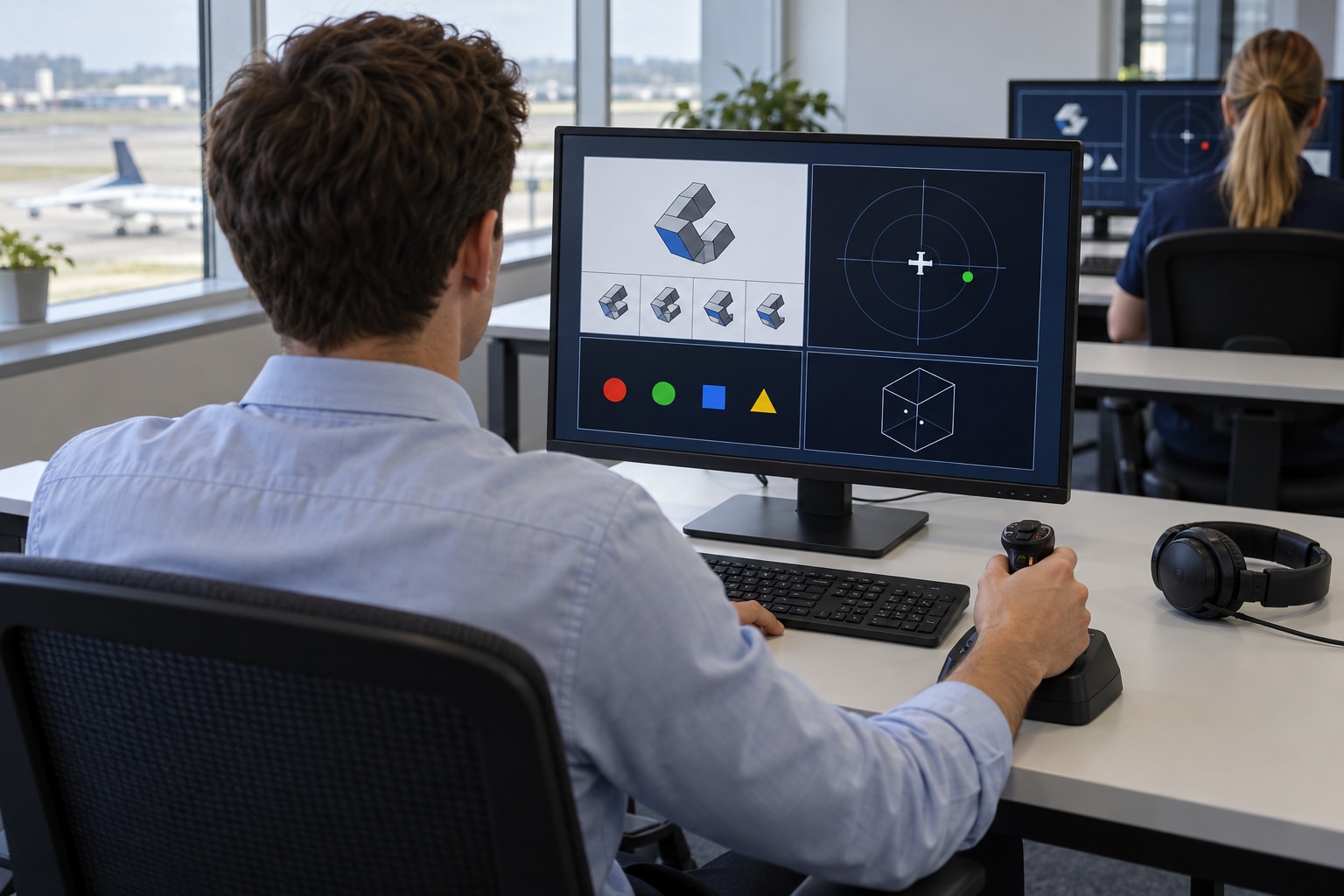
| Attention and multitasking | Track a symbol or target while responding to another stream of prompts | Divided attention, memory and control consistency |
| English comprehension | Read instructions or a short passage and select the supported conclusion | Accurate interpretation under time pressure |
Timing changes the strategy: unanswered questions may score no better than wrong ones, while some systems record accuracy and reaction time separately. Confirm whether sections allow skipping, return to earlier questions, or show a countdown before practising.
Run one untimed diagnostic, then repeat each weak category under progressively shorter limits. Label every error as arithmetic, misreading, spatial reversal, attention loss, control overcorrection or poor time management; repeating familiar questions can hide the real weakness.
Build Numerical and Spatial Accuracy Without a Calculator
Use short, timed sets without a calculator, because aptitude tests reward a correct setup as much as a fast answer. Start with school-level arithmetic, then reduce the time limit only after your accuracy stays above 90%. Do not spend preparation time on calculus.
Practise these drills:
- Mental addition, subtraction, multiplication, division, fractions, percentages and ratios.
- Speed-distance-time calculations using the three forms: distance = speed × time, speed = distance ÷ time, and time = distance ÷ speed.
- Unit conversions between kilometres and nautical miles, metres and feet, hours and minutes, and litres and gallons. Write the conversion factor before calculating.
- Fuel, rate and consumption questions, plus tables and graphs. Estimate the answer first so a misplaced decimal stands out.
- Spatial exercises involving compass directions, relative bearings, map orientation and mentally rotating an aircraft or object through 90°, 180° or 270°.
For each session, record the question number, time taken and error type. Mark arithmetic slips separately from misreading, a reversed direction or a wrong spatial rotation; repeating familiar questions can hide the weakness. Rework every error untimed, explain the setup aloud, then attempt a new question of the same type under a shorter limit.
Keep accuracy ahead of speed: rushing through a numerical set or overcorrecting a mental rotation creates errors that a faster response cannot recover.
Train Attention, Coordination and Decisions Under Pressure
Do not chase speed until your accuracy is stable. Start with a moving-target task and a simple visual or auditory prompt, then record both tracking errors and reaction time. If the target drifts while you answer prompts, slow down until you can protect the primary task before shortening the time limit.
Use short, repeatable drills to build multitasking, working memory and hand-eye coordination:
- Track a dot with the mouse or joystick while responding to a changing number or sound.
- Hear a sequence of digits, repeat it backward, then increase the sequence by one item after two correct attempts.
- Press the correct key when a target appears, but withhold the response for a designated “do not press” signal.
- Make small control inputs and return to centre; large corrections teach the wrong habit.
After each session, classify every mistake as a memory omission, missed prompt, slow reaction time, control overcorrection or decision error. Practise the weakest category under a shorter limit, but keep a minimum accuracy threshold; speed gains that produce repeated misses are not progress.
Learn the test’s control mapping before adding pressure. A joystick on a simulator will not automatically match a computer test, and unfamiliar sensitivity can turn smooth tracking into oscillation. The day before, protect sleep, eat and hydrate normally, avoid unfamiliar caffeine or medication, and arrive early so instructions and equipment do not consume test time.
Use a Four-Week Plan and Review Results Intelligently
One month before testing, obtain the organiser’s exact sections, time limits, calculator rules and scoring method. Take two timed practice tests each week, then log every error as a knowledge gap, misread question, slow method or careless click. If negative marking applies, record guesses separately from errors.
1. Four weeks out, practise on alternate days: numerical reasoning, spatial rotation, coordination, memory and English comprehension. Review the error log before each session. If you are pursuing an Indian CPL, arrange the initial Class 1 medical with an authorised DGCA medical examiner before committing substantial flight-training money; aptitude performance cannot resolve a medical problem.
2. One week out, complete two or three full practice tests at the scheduled start time. Stop adding new topics. Use results to adjust pacing: reserve time for difficult items only when the scoring system rewards returning to them, and avoid blind guesses when negative marking makes them costly.
3. One day before, prepare identification, confirmation email, glasses and travel route. Sleep normally, drink water, avoid unfamiliar medication or excessive caffeine, and arrive early enough for registration and equipment checks.
Guided preparation is useful when your scores stall, timing remains uneven, or you cannot identify why answers are wrong. Ask the instructor to inspect your error log and replicate the provider’s interface, rather than selling you DGCA theory for an aptitude battery.
SKYJET PILOT TRAINING ACADEMY can help separate DGCA ground-study needs from aptitude practice when you are planning both.
Frequently asked questions
What does a pilot aptitude test measure?
It measures information processing, numerical reasoning, spatial orientation, attention, memory, coordination, reaction speed, English comprehension and decision-making under time pressure.
How can you improve numerical and spatial aptitude without a calculator?
Practise mental arithmetic, percentages, ratios, estimation, unit conversions and mental rotation while recording both accuracy and completion time.
How should you practise coordination and multitasking?
Combine tracking, monitoring, memory and response tasks, then increase speed only after you can maintain accurate control.
How do you prepare for a pilot aptitude test in four weeks?
Use the first week to establish a baseline, build core skills in weeks two and three, and use week four for timed simulations and targeted review.