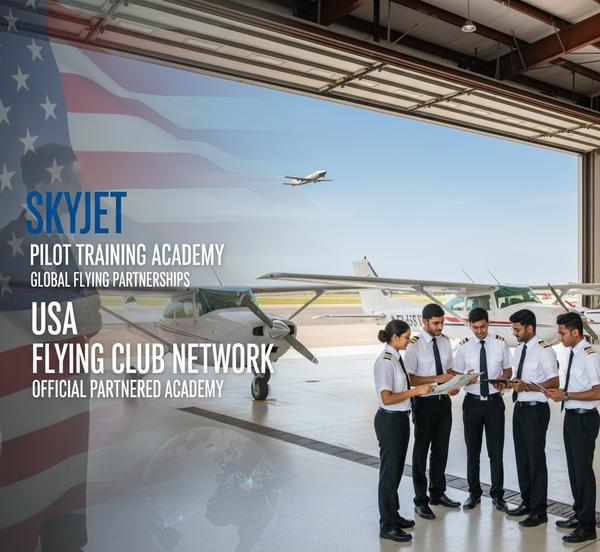
The path typically involves obtaining a FAA (Federal Aviation Administration) CPL in the USA, followed by the mandatory DGCA (Directorate General of Civil Aviation) license conversion process upon returning to India. Pilot training in the United States offers significant advantages for Indian students, especially in terms of speed and efficiency. Due to favorable and consistent flying weather, students can often complete their training within 8 to 12 months, compared to 18–24 months in many other countries. The training is conducted under the highly regulated standards of the Federal Aviation Administration (FAA), ensuring world-class quality, modern aircraft, advanced simulators, and well-structured programs that meet global aviation benchmarks. Another major benefit is the global recognition of the FAA license, which is fully compliant with ICAO standards and widely accepted across the aviation industry, providing a strong foundation for an international flying career. Additionally, certain flight schools offer programs under the F-1 visa, allowing students to gain post-training work authorization—such as working as a flight instructor—to build the required 1,500 flight hours needed for an Airline Transport Pilot License (ATPL), significantly enhancing career progression opportunities. Eligibility & Prerequisites: To begin pilot training, candidates must meet specific age and educational requirements. Students can start their Private Pilot License (PPL) training at a minimum age of 17, while they must be at least 18 years old to apply for a Commercial Pilot License (CPL). Academically, it is mandatory to have completed 10+2 (Higher Secondary) with Physics and Mathematics, as these subjects form the foundation for understanding aviation principles and flight operations. In addition, medical fitness and English proficiency are crucial for a successful aviation career. Candidates must obtain an FAA Class 2 Medical Certificate to begin CPL training, and later secure a DGCA Class 1 Medical for license conversion and employment in India under the Directorate General of Civil Aviation. While exams like IELTS or TOEFL may not always be mandatory to start flying, a strong command of English is essential for visa processes, training, and effective communication in international aviation environments. The CPL Training Process (FAA License): The Commercial Pilot License (CPL) training process in the United States, governed by the Federal Aviation Administration (FAA), follows a structured modular approach designed to build skills progressively. It begins with the Private Pilot License (PPL), where students learn fundamental flying techniques and basic aircraft handling primarily for personal flying. This is followed by the Instrument Rating (IR), which enables pilots to operate under Instrument Flight Rules (IFR), allowing them to fly safely in low-visibility and challenging weather conditions. The final stage is the Commercial Pilot License (CPL), which requires a minimum of 250 total flight hours under Part 61 (or fewer under Part 141), along with specific requirements for cross-country, night flying, and Pilot-in-Command (PIC) experience. To further enhance career opportunities, pilots also obtain a Multi-Engine Rating (MEL), which is essential for operating twin-engine commercial aircraft and is highly valued by airlines worldwide. Visa & Security Clearance Requirements: To pursue pilot training in the United States, Indian students must first obtain the appropriate visa, most commonly the M-1 Student Visa, which is specifically designed for vocational training programs like aviation. To apply, candidates must receive a Form I-20 from a SEVP-approved flight school. In some cases, flight schools affiliated with colleges may offer the F-1 visa, which provides additional benefits such as Optional Practical Training (OPT) after course completion. Alongside the visa application, students are required to pay the SEVIS (Student and Exchange Visitor Information System) fee, which is mandatory for tracking and maintaining their student status in the U.S. In addition to visa formalities, all non-U.S. citizens must undergo a security clearance through the Transportation Security Administration (TSA) under the Alien Flight Student Program (AFSP). This background check is compulsory before commencing any flight training and ensures compliance with U.S. aviation security regulations. Completing these steps is essential for a smooth admission process and to legally begin pilot training in the United States. Cost and Duration (Estimated): Total Cost (CPL + Ratings): Approximately $70,000 to $90,000 USD, depending on the flight school, aircraft used, and student efficiency. Living Expenses: Add roughly $1,000 – $1,500 USD per month for accommodation, food, and transport. Duration: 10 to 12 months (Full-time dedication and good weather are key). FAA to DGCA Conversion (Mandatory to work in India): To work as a pilot with an Indian airline, candidates holding an FAA Commercial Pilot License (CPL) must convert it into a CPL issued by the Directorate General of Civil Aviation (DGCA). This is a crucial final step that ensures compliance with Indian aviation regulations. As part of the conversion process, candidates are required to clear key DGCA theory examinations—Air Regulations, Composite Navigation, and Meteorology—if they haven’t already been completed in India. Additionally, applicants must hold a valid DGCA Class 1 Medical Certificate to meet the required fitness standards for commercial flying. Furthermore, the candidate’s FAA logbook must meet DGCA-mandated minimum flying hours, including requirements such as total flight time, Pilot-in-Command (PIC) hours, cross-country flying, and multi-engine experience, all of which must be properly verified. A skill test (check ride) is also conducted by a DGCA-approved examiner on an Indian-registered aircraft to assess flying proficiency. Lastly, obtaining the RTR (A) license—issued by the Wireless Planning and Coordination Wing (WPC)—is mandatory, as it certifies the pilot’s ability to handle aeronautical radio communication effectively. Flight Training: Flight training in the United States has become increasingly popular among Indian students, making it one of the most preferred destinations for obtaining a Commercial Pilot License (CPL). The country is globally recognized for its advanced aviation infrastructure, offering a vast network of flight schools and modern training facilities. With access to diverse airspace and strict safety regulations, students receive high-quality instruction that equips them with the technical skills and confidence required for a successful aviation career. Weather for Flight Training: The USA’s geographical diversity provides an exceptional advantage for flight training, as students experience a wide range of weather conditions. From clear skies in desert regions to challenging winter climates in northern states, this variety helps aspiring pilots develop strong decision-making and adaptability skills. Additionally, the country’s advanced meteorological systems ensure accurate weather forecasting, enabling safe and well-planned training sessions throughout the program. Living in USA: Living in the United States offers students unmatched global exposure and personal growth opportunities. The multicultural environment allows interaction with people from diverse backgrounds, enhancing communication skills and confidence. Along with access to highly experienced instructors and world-class training standards, pilot training in the USA is often considered cost-effective, making it an attractive option for students seeking quality education and international career prospects in aviation.
Address
Royal House building, Karve Rd, near sheetal veg hotel, statue, Kothrud, Pune, Maharashtra-411004
Pune, India, 411004