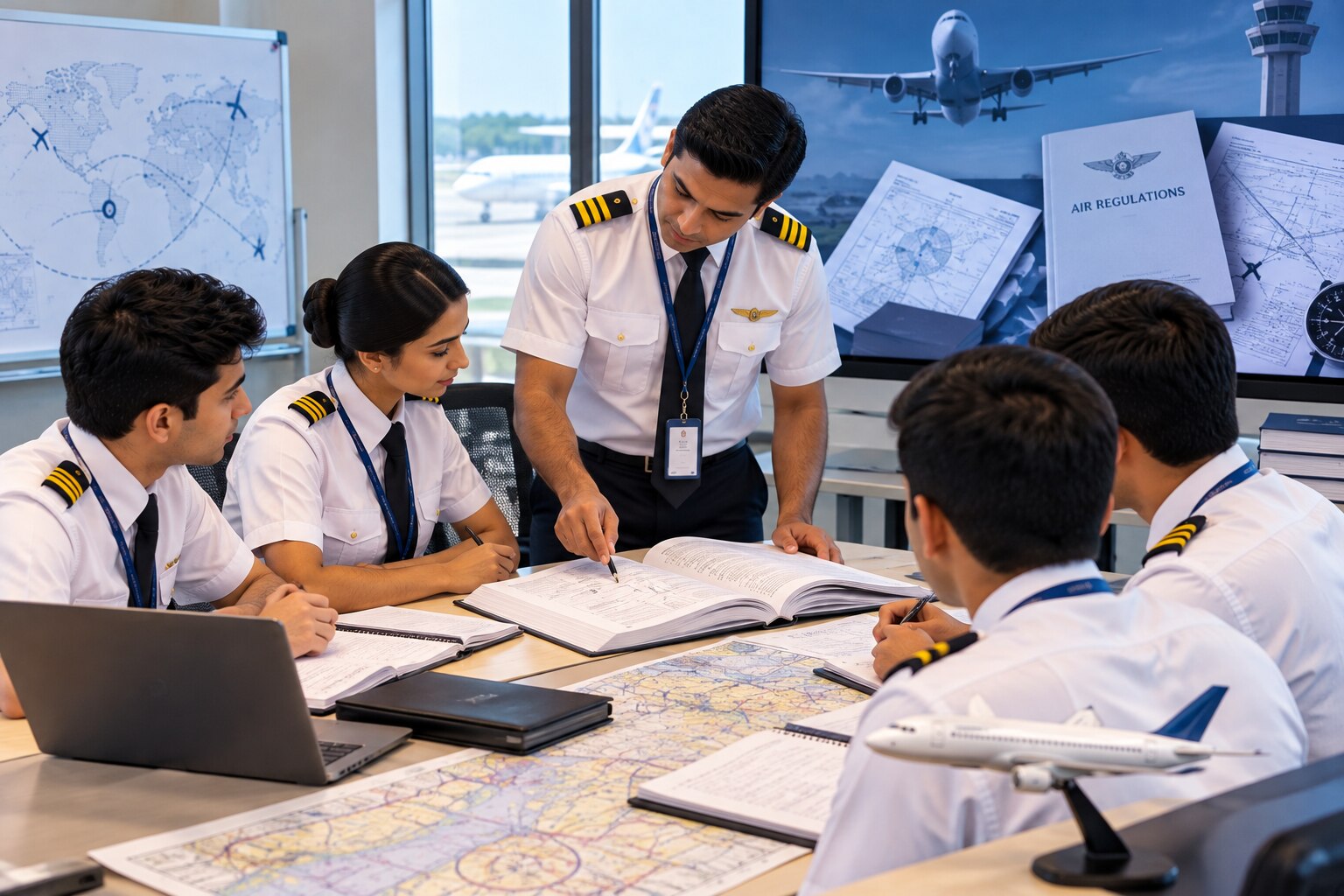
Air regulations determine who may fly, where an aircraft may operate, what information must be checked, and how pilots interact with Air Traffic Services. By the end, you will be able to distinguish the main Indian rule sources, apply them during a student flight, understand your responsibility after receiving a clearance, and see how Air Regulations study fits alongside CPL and RTR (A) requirements.
Key takeaways
- Keep the Aircraft Act, Aircraft Rules, and DGCA requirements current.
- Check airspace, weather, minimum heights, and right-of-way before departure.
- Follow ATC instructions while retaining pilot-in-command responsibility.
- Apply correct radio, flight-planning, signal, and reporting procedures.
What Air Regulations Cover—and How They Differ from Other Subjects
Air Regulations tells you what a flight is legally allowed to do, who may conduct it, and which procedures apply. In India, the subject draws on the Aircraft Act, 1934, the Aircraft Rules, 1937, DGCA requirements, airspace procedures, right-of-way rules, minimum safe heights, VFR and IFR operations, signals, and pilot-in-command responsibilities.
| Subject | Main question | What you apply in flight |
|---|---|---|
| Air Regulations | Is this operation legal and properly authorised? | Rules of the air, clearances, airspace, circuits and reporting |
| Aircraft Systems | How does the aircraft operate? | Engines, flight controls, electrics, instruments and limitations |
| Navigation | Where am I, and how will I reach the destination? | Charts, headings, tracks, distances, radio aids and position fixing |
| Meteorology | What weather will affect the flight? | Wind, visibility, cloud, pressure, temperature and hazards |
| Radio Telephony | How do I communicate correctly? | Phraseology, frequencies, readbacks and emergency transmissions |
Air Regulations is one paper in DGCA flight-crew theory, and each applicable paper generally requires at least 70%. Passing it does not grant a CPL or a Radio Telephony Restricted (Aeronautical) qualification; those require separate examinations, training, medical, experience, skill-test and documentation requirements. A theory pass also does not authorise international operations.
You must use current sources, because an old handout cannot replace amendments, Civil Aviation Requirements, the India AIP or NOTAMs.
The Indian Rule Sources You Must Keep Current
A flight can be legal at 0900 and unlawful at 1100 if a temporary restriction, runway closure, or route change takes effect. Before accepting a clearance, use the current source set—not an old coaching handout—and check each document against the flight date, route, aircraft, and aerodrome.
| Source | What it tells you | What to check before flight |
|---|---|---|
| Aircraft Act, 1934 and Aircraft Rules, 1937 | Statutory powers, licensing, operating, and safety obligations | Whether your licence, aircraft operation, and conduct meet the governing law |
| Directorate General of Civil Aviation (DGCA) | Regulatory oversight, directions, circulars, and licensing requirements | Current amendments and notices affecting your operation |
| Civil Aviation Requirements (CARs) | Detailed DGCA standards for crew, operations, training, and records | The applicable CAR series, revision, and compliance conditions |
| Aeronautical Information Publication (AIP) India | Permanent aerodrome, airspace, route, procedure, and reporting information | Effective pages, amendments, and procedures for your destination |
| Notices to Airmen (NOTAMs) | Time-sensitive closures, hazards, restrictions, outages, and changed procedures | Validity period, location, altitude, and effect on your route or alternates |
The AIP India is not a one-time textbook. Review its amendments and supplements, then read NOTAMs issued for departure, destination, alternates, and the planned route through the available Airports Authority of India aeronautical information service. DGCA circulars and amendments can change how a CAR applies before your next lesson.
Your instructor or operations desk may provide the briefing, but you remain responsible for understanding restrictions and refusing a flight you cannot legally conduct. Record the source and revision used; that habit exposes stale information before it reaches the cockpit.
Rules That Shape Every Flight
A student pilot uses air regulations to choose an altitude, route, clearance response, and escape action—not to recite legal text. The rules of the air turn traffic information into decisions: who manoeuvres, where, under which flight rules, and what happens when visibility or communications deteriorate.
- Right of way: give way as prescribed, but keep scanning; priority never excuses collision risk.
- Minimum safe heights: remain clear of people, property, and terrain at the prescribed height, except for authorised take-off, landing, or training.
- Altimeter-setting procedures: set the pressure value issued for the area, verify transition instructions, and use standard 1013.25 hPa above the transition level.
- VFR: continue only with required visibility, cloud clearance, visual reference, and reporting.
- IFR: follow the clearance, published instrument procedure, assigned level, and instrument approach limits.
- Airspace classifications: identify whether the route is controlled or uncontrolled and comply with its entry, communication, and separation requirements.
- Circuits and signals: use the published traffic pattern; interpret markings, marshalling, and light signals when radio contact fails.
An ATC clearance does not make an unsafe or unlawful action acceptable. The pilot-in-command remains responsible: read back applicable clearances, check them against aircraft limits and weather, and query any conflict. This practical judgment is the point of studying regulations.
Who Gives Instructions and Who Remains Responsible
DGCA regulates India’s civil aviation system: it issues licensing standards, approves training and examinations, oversees aircraft operations and maintenance, and enforces the Aircraft Act, Aircraft Rules, and Civil Aviation Requirements. It does not direct your aircraft on a particular flight.
- Airports Authority of India (AAI) operates many Indian airports and provides airport infrastructure, navigation facilities, communications, and Air Traffic Services (ATS) at designated locations.
- ATS is the wider service framework that includes flight information, alerting, and control services. Air Traffic Control (ATC) is the control function within ATS, issuing clearances and instructions to manage traffic safely and efficiently.
- ATC controls traffic sequencing, runway use, headings, altitudes, routes, and reported or assigned restrictions within its jurisdiction. A clearance authorises an operation under stated conditions; it does not make an unlawful or unsafe action acceptable.
- The pilot-in-command remains responsible for the aircraft’s safe operation, including fuel, performance, weather decisions, aircraft limitations, collision avoidance, and compliance with applicable rules.
Before accepting a clearance, use this sequence:
- Confirm the aircraft callsign and read back every applicable clearance, runway, route, level, heading, and restriction.
- Compare it with your flight plan, aircraft performance, fuel, equipment, published procedures, NOTAMs, weather, and the traffic situation.
- Challenge any error or ambiguity immediately. Ask ATC to repeat or amend the clearance if it conflicts with an aircraft limitation, an instruction already received, or a safe course of action.
- If necessary, state “unable” and explain why. Acceptance never transfers responsibility from the pilot-in-command.
Applying the Rules: From Flight Planning to Radio and Reporting
A compliant student flight applies the rules at every stage, not only during the examination. You brief the weather, confirm the aircraft and aerodrome status, check NOTAMs and airspace restrictions, and match the route to flight plan requirements before engine start.
1. File the required flight plan with accurate departure, destination, route, endurance, persons on board, and aircraft details. Update or cancel it when the flight changes; an unreported landing can trigger unnecessary search-and-rescue action.
2. Fly the published circuit: join at the authorised point and height, maintain spacing, observe right-of-way, and follow light or radio instructions. Never treat another aircraft’s mistake as permission to lose separation.
3. Use standard phraseology and make readbacks of clearances, runway instructions, altimeter settings, and assigned levels. If you experience loss of communication, follow the aircraft’s published radio-failure procedure and continue reporting or landing as required by the applicable rules.
4. In an emergency, aviate, navigate, communicate, select 7700 when appropriate, transmit the nature of the problem and intentions, and use the correct distress or urgency call. Your instructor should rehearse engine failure, forced landing, radio failure, and interception procedures.
5. Treat RTR (A) as a separate radio-telephony qualification; passing the DGCA Air Regulations paper does not grant it. Training at SKYJET PILOT TRAINING ACADEMY should make you practise the exact calls, readbacks, and decisions you will be assessed on.
CPL eligibility also requires the prescribed medical, examinations, records, skill test, and experience—not merely a logbook total. The commonly stated aeroplane standard is 200 hours, including 100 pilot-in-command and 50 cross-country PIC hours, plus specified instrument and night experience; verify current DGCA crediting rules.
Related product
 | DGCA - Ground School Air Regulation Course Air Regulation Course in India – DGCA CPL Training at Skyjet Pilot Training Academy At Skyjet Pilot Training Academy, the Air Regulation course in... |
Frequently asked questions
What does Air Regulations cover during pilot training?
Air Regulations covers the legal limits of flight, pilot authority and responsibility, airspace procedures, right-of-way, minimum safe heights, VFR and IFR operations, signals, and reporting requirements.
Which Indian rule sources must pilot trainees keep current?
Pilot trainees must track the Aircraft Act, 1934, the Aircraft Rules, 1937, current DGCA requirements, and published airspace and operational procedures.
Who is responsible when a pilot receives an instruction from ATC?
ATC provides instructions within its authority, but the pilot-in-command remains responsible for the safe conduct of the flight and must address unsafe or conflicting instructions.
How do Air Regulations apply during flight planning?
They guide your route, airspace use, weather and visibility checks, minimum safe heights, VFR or IFR choice, radio procedures, right-of-way decisions, and required reports.