An airline cockpit is reached through several separate gates: academic eligibility, medical certification, DGCA examinations, logged flight experience, licence issue and airline selection. By the end, you will know what each organisation supplies, which records and checkpoints matter, and how to judge whether a student is ready for a first-officer assessment rather than merely qualified to hold a CPL.
Key takeaways
- Confirm age, 10+2 Physics and Mathematics, and DGCA medical eligibility.
- Check the academy’s current DGCA-approved FTO documentation before paying.
- Review how the course records flight hours and supports DGCA examinations.
- Treat a CPL as the starting point, not a guarantee of airline selection.
The pathway starts with eligibility, medical clearance and the right training provider
Before paying for full flight training, confirm pilot eligibility India: you must be at least 18 for a Commercial Pilot Licence, hold 10+2 or an equivalent qualification with Physics and Mathematics, and satisfy DGCA medical standards.
Complete a DGCA Class 2 medical early; an authorised examiner can identify eyesight, hearing, colour-vision, cardiovascular or other issues before you commit substantial money. Obtain the DGCA Class 1 medical before CPL issue and airline applications.
Keep identity proof, education certificates, medical reports and examination applications organised from the start. The responsible organisation differs at each checkpoint:
| Organisation | Responsibility | Student checkpoint |
|---|---|---|
| Aviation academy | Ground-school teaching and DGCA examination preparation | Verify the syllabus, attendance process and academic support |
| DGCA-approved Flight Training Organisation | Aircraft, instructors, approved syllabus, flight hours, logbooks and skill tests | Check current approval, aircraft availability, maintenance delays and record controls |
| DGCA | Medical standards, examinations, licensing rules and CPL issue | Submit applications, pass required subjects and complete licence paperwork |
| Wireless Planning and Coordination authorities | Radio Telephone Restricted (Aeronautical) examination | Pass the separate communications examination |
| Airline or cadet programme | Selection and employment decision | Meet its own age, licence, aptitude and assessment rules |
The aviation academy versus flight training organisation distinction matters: classroom completion does not create flight hours, and an FTO does not guarantee an airline job. The FTO’s signed records, aircraft registrations, instructor entries and skill-test documents become evidence for your CPL application.
From DGCA examinations to a licence-compliant flight record
Passing the DGCA CPL examinations proves theoretical knowledge, not flight competence. A licence-compliant programme connects three tracks:
- Ground instruction for aviation knowledge and regulations.
- Flight training that builds the required experience.
- Practical checks and records that prove each requirement was met.
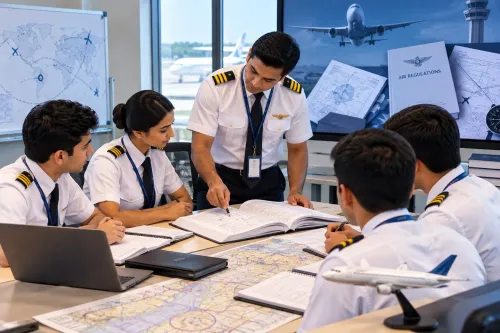
Ground preparation covers separate papers, including:
- Air Regulations
- Air Navigation
- Aviation Meteorology
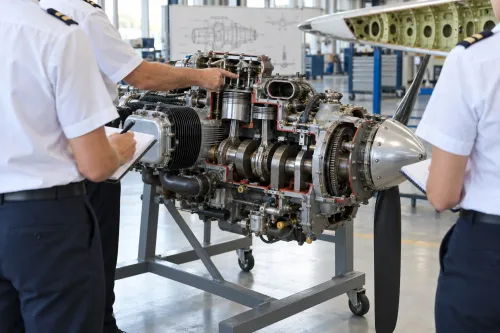
- Aircraft and Engine (Technical General)
The Radio Telephone Restricted Aeronautical examination is separate from the DGCA papers. It tests your ability to use aviation radio procedures; passing the written subjects alone does not establish legal, effective radio communication.
The aeroplane 200 hours CPL requirement is not satisfied by simply flying until the total reaches 200.
The record must show the prescribed experience, including 100 hours as pilot-in-command, 50 hours of cross-country flight as pilot-in-command, 40 hours of instrument time within simulator-credit limits, and 10 hours of night flying with the required take-offs, landings and cross-country experience.
An authorised examiner then assesses the required practical skills, including aircraft handling, navigation, instrument procedures and emergency responses. A failed check needs corrective training and a documented re-test; extra hours do not erase an incomplete check.
Your pilot logbook ties the evidence together. Keep aircraft registration and type entries, dates, routes, flight times, instructor signatures, examination passes, medical records and skill-test reports consistent before submitting the CPL application. Missing signatures or mismatched totals can delay licence issue even after the flying is complete.
What airline preparation looks like before a student applies
During a normal training week, airline pilot preparation turns broad progress into evidence: lesson objectives, instructor grades, flight debriefs, examination scores and updated records. Passing DGCA knowledge examinations matters, but it does not prove accurate radio work, procedural discipline or readiness to operate in a multi-crew cockpit.
- Set weekly targets for DGCA revision, aircraft handling, instrument procedures, radio communication and checklist use. Record the result after each ground or flight lesson, including errors that require a repeat.
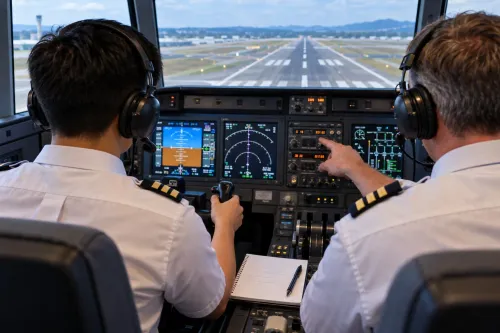
- Use instrument training to measure heading, altitude, navigation and approach accuracy under workload. A simulator session can support licence requirements, but airline readiness also demands automation management, crew coordination and strict adherence to standard operating procedures.
- Review the pilot logbook each week. Check aircraft registration and type entries, pilot-in-command and cross-country totals, night and instrument time, instructor signatures, examination passes, medical documents and skill-test records; one missing entry can delay a licence or airline application.
- Hold a pilot progress review with an instructor or training manager. Compare actual hours, check-ride results and outstanding weaknesses against the planned CPL and airline-readiness milestones.
- Practise airline selection tasks through technical questioning, structured answers, radio scenarios, crew-resource-management exercises and a mock interview for pilots. Assess communication, judgement and accuracy rather than memorised speeches.
A student is ready to apply when the records support the claimed experience and repeated assessments show safe, consistent performance. A CPL alone is not that evidence; multi-engine instrument work, simulator exposure and professional habits still need deliberate development.
Why a CPL is only the starting point for airline selection
A CPL proves you meet the DGCA licensing standard; it does not qualify you automatically as an airline first officer. Airlines still test whether you can apply knowledge accurately, manage workload, communicate clearly and follow standard operating procedures in a crew environment.
Selection commonly includes:
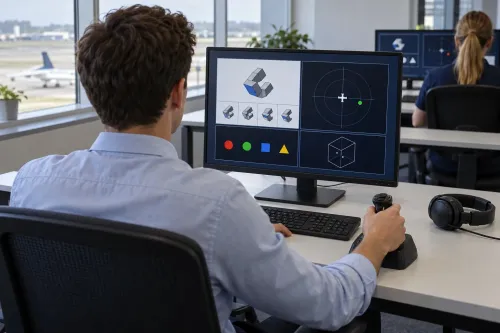
- An airline pilot aptitude test covering numerical reasoning, memory, multitasking and spatial awareness.
- An airline technical interview on aircraft systems, performance, meteorology, navigation and regulations.
- A pilot simulator assessment measuring instrument flying, handling, automation management and crew coordination.
- HR, communication, psychometric or group exercises against the operator’s eligibility rules.
Treat multi-engine training as airline preparation, not a box-ticking flight-hour purchase. Choose training that builds airline-standard instrument and engine-failure skills in a crew environment. Keep the logbook, aircraft registration, instructor signatures, skill-test reports and examination records consistent; poor documentation can delay an assessment even when your flying is sound.
Make the type rating decision only after checking the airline’s written requirements, financing terms and hiring route. A rating for an Airbus A320 or Boeing 737 does not guarantee employment, and self-funding it before securing a credible selection pathway can leave you with substantial cost and no cockpit seat.
Approach first-officer recruitment as a staged competition: meet the operator’s published conditions, prepare for technical and aptitude tests, practise simulator profiles and CRM, then apply with complete, verifiable records. Ask who provides multi-crew or type training and who controls the hiring decision.
How to compare an academy, FTO and airline pathway before paying
Before paying, match each promise to the organisation that controls the outcome. An academy teaches theory and preparation; a Flight Training Organisation (FTO) provides aircraft, instructors and licence-compliant flight records; an airline controls selection; a consultancy advises or introduces candidates but cannot guarantee employment.
| Option | What it means | What to verify |
|---|---|---|
| Academy | Ground training and airline preparation | Faculty continuity, mock assessments, Radio Telephony Restricted (Aeronautical) guidance and record support |
| DGCA-approved FTO | Flight training and official records | Current approval, approved syllabus, pilot training aircraft availability, maintenance interruptions and instructor continuity |
| Airline cadet programme | Airline-linked selection and training route | Written eligibility rules, selection stages, refund terms, training provider and whether a job is guaranteed or conditional |
| Pilot placement consultancy | Recruitment assistance | Named airline vacancies, written service fees and proof of employer authority; reject guaranteed-job claims |
Use a DGCA-approved FTO checklist before signing: inspect a sample logbook entry showing aircraft registration, instructor signature, flight time and exercise; ask how missing records are corrected; and confirm who submits skill-test and CPL paperwork. A large advertised fleet means little if aircraft remain unserviceable.
Test communication before enrolling. Ask for a radio-communication practice session and feedback on clarity, readbacks, and standard phraseology—not only DGCA subject results.
Treat a type rating as a major financial decision. Request the airline’s written eligibility criteria, simulator assessment process, bond terms and recruitment history. SKYJET PILOT TRAINING ACADEMY can be compared on these measurable checks, not promotional claims.
Related products
 | DGCA Approved Flying School Pilot Training in Indian Flying school (DGCA CPL) While training abroad offers speed, pursuing a Commercial Pilot License (CPL) through an Indian flying club or Flight Training Organisation (FTO)... |
 | DGCA - Ground School Aviation Meteorology Classes Aviation Meteorology Classes for DGCA CPL – Complete Training Guide At Skyjet Pilot Training Academy, Aviation Meteorology is not just a subject—it... |
Frequently asked questions
What must you confirm before starting commercial pilot training in India?
Confirm that you are at least 18, hold 10+2 or an equivalent qualification with Physics and Mathematics, and meet DGCA medical standards.
How does an academy support DGCA examinations and flight training?
It provides structured ground preparation for DGCA examinations and helps maintain a flight record that meets licence requirements.
Does earning a CPL guarantee an airline job?
No. A CPL is the starting qualification; airline selection also depends on preparation for assessments, interviews, technical evaluation and other hiring requirements.
What should you compare before paying an aviation academy?
Compare the academy’s DGCA approval, training structure, aircraft and instructor access, record-keeping process, total training pathway and support after the CPL.
Related products
 | DGCA Approved Flying School CPL in the USA for Indian Students The path typically involves obtaining a FAA (Federal Aviation Administration) CPL in the USA, followed by the mandatory DGCA (Directorate General of... |
 | DGCA - Ground School Air Regulation Course Air Regulation Course in India – DGCA CPL Training at Skyjet Pilot Training Academy At Skyjet Pilot Training Academy, the Air Regulation course in... |
 | DGCA - Ground School Technical General DGCA CPL Technical General: Complete Guide to Aircraft Systems & Aerodynamics Technical General is one of the most important and conceptually... |
 | DGCA Approved Flying School CPL Training in South Africa South Africa, a leading aviation hub and an ICAO contracting state, is one of the most practical and cost-effective destinations for Indian students... |