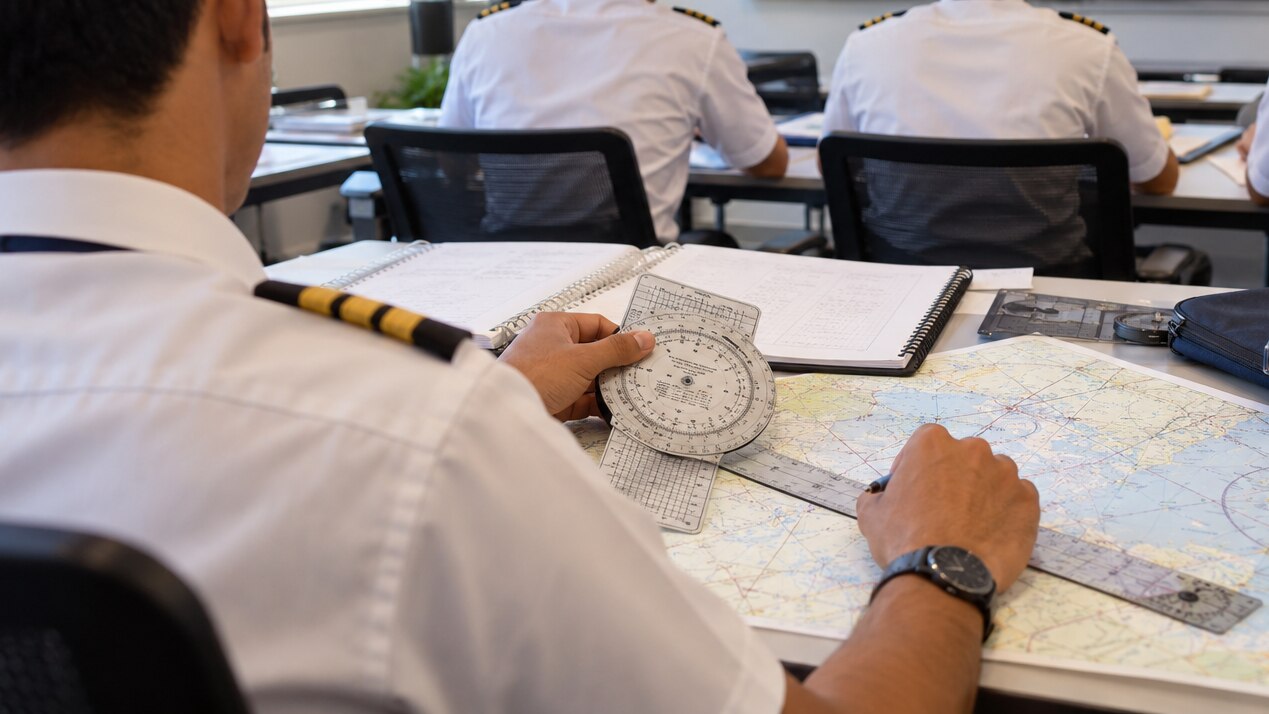
Passing DGCA papers requires more than completing classroom hours or memorising a question bank. You need an examination plan that matches the subject sequence, current application process, available study time and the difference between theory coaching and the full CPL licence pathway.
Key takeaways
- Confirm 10+2 Physics and Mathematics before booking a DGCA paper.
- Start your Class 1 medical process before committing to costly flight training.
- Study CPL subjects in a planned sequence, then revise with timed practice.
- Compare faculty, doubt support, mock tests and progress tracking before enrolling.
What must you complete before booking a DGCA paper?
Confirm 10+2 or an equivalent qualification with Physics and Mathematics before booking a DGCA paper. Start the Class 1 medical process early; a later medical issue can stop licence issue after costly training.
- Create or update your account on the DGCA eGCA portal and obtain your computer number before submitting an examination application.
- Assemble CPL eligibility documents: government identity, 10+2 marksheets or equivalent education proof, medical records, photographs and training documents. Check names and dates across every document.
- Submit the DGCA exam application, select an available examination session and choose the required paper. Verify the current fee, closing date, cancellation, correction and scheduling rules on the DGCA portal before publication or payment.
- Check the portal and registered email for the examination communication or admit card. Carry the specified admit card and original government photo identification matching your application; do not rely on a photocopy unless the current instructions permit it.
- Use DGCA-approved question-bank material to practise wording, timing and recurring concepts, but also solve reworded questions and calculations. Memorising answer sequences will fail when the question changes.
- After an unsuccessful attempt, check the published result, identify the failed paper and read the current DGCA instructions for any reapplication or waiting requirement. Then submit the next application and book the next available attempt.
A written pass is only one licence requirement. You still need a valid Class 1 medical, required flight experience, skill test, documentation and the separate RTR(A) qualification; normal aeroplane experience is 200 hours, with 150 hours applying only to an approved integrated course.
In what order should you study the CPL subjects?
1. Start with Technical General. Build the foundation through aircraft systems, engines, aerodynamics and performance concepts; without it, aircraft-specific facts become disconnected memorisation.
2. Add Technical Specific after you obtain the actual Pilot’s Operating Handbook (POH) or Aircraft Flight Manual (AFM) for the aircraft used in training. Learn its limitations, systems, speeds, performance tables and emergency procedures from that document, not from a generic question bank.
3. Begin Air Navigation after you can handle the mathematics, units and time-speed-distance relationships. Progress to charts, headings, wind correction, dead reckoning and flight-planning logic before attempting timed Air Navigation calculations.
4. Study Aviation Meteorology alongside navigation. Your Aviation Meteorology revision becomes useful when you can interpret pressure, wind, cloud, visibility, fronts, icing and weather reports, then apply them to route and fuel decisions.
5. Keep Air Regulations in short sessions from the first week. Connect each rule to an operational decision, such as equipment, airspace, right of way or flight-time limitation, instead of cramming the paper in the final days.
A workable seven-day CPL subject sequence uses six study days with two blocks daily. Allocate Technical General or Technical Specific on three days, Navigation on two, and Meteorology on two; overlap subjects on selected days, and spend 15–20 minutes on Regulations every day. Keep one day for recovery and error review.
Adjust block length after a diagnostic test.
Night, instrument, cross-country and performance topics need more than question-bank familiarity. Understand the procedure, assumptions, limitations and calculation behind each answer, because reworded operational questions expose memorisation quickly.
What does an effective daily and weekly revision system look like?
Use the same cycle after every CPL class: review within 24 hours, recall without notes, solve, practise, then diagnose. A repeatable day looks like this:
- Reconstruct the lesson from memory before reopening your notes.
- Work two or three navigation or performance calculations, showing units and intermediate steps.
- Complete question-bank practice, then solve one reworded question or operational scenario.
- Add one short entry to your CPL error log.
Label every error precisely so revision fixes the cause:
| Error label | What to check |
|---|---|
| Knowledge gap | Did you understand the rule, system or concept? |
| Formula mistake | Did you select or rearrange the formula incorrectly? |
| Unit conversion | Did you confuse knots, kilometres, nautical miles, feet or hours? |
| Misread question | Did you miss words such as “least”, “maximum” or “not”? |
| Careless calculation | Was the method correct but the arithmetic wrong? |
| Guessing | Did you choose correctly without knowing why? |
Maintain a navigation formula sheet and a performance formula sheet. Do not copy formulas mechanically: derive each one, state what every symbol means and explain when the formula fails.
Use spaced repetition for pilots at 1, 3, 7 and 14 days. Put definitions, limitations, regulations and technical facts on flashcards. Schedule one untimed topic test early in the week and one timed mixed paper at the weekend. Review every DGCA mock test, including correct guesses, and increase full-mock frequency near the examination.
Set next week’s target as an accuracy or error-reduction measure, not a question count.
Which CPL class format and level of support fit your situation?
Choose the format by the support you need, not by a pass-rate claim. Classroom CPL coaching suits beginners who lack Physics, Mathematics or aviation fundamentals, or who need a fixed timetable and attendance pressure.
| Format | Direct help and doubt speed | Attendance, technology and practice |
|---|---|---|
| Classroom | Ask immediately; peers explain alternative methods | Requires travel and attendance; supervised mocks and discussion are strongest |
| Live-online DGCA classes | Fast help during sessions; depends on instructor response | Needs reliable internet and a computer; recordings help revision, but not live participation |
| Self-study for CPL exams | You solve doubts independently through approved references | Flexible attendance; demands strong discipline, scheduled mocks and uninterrupted study time |
Choose a single-subject course after failing or repeatedly struggling with one paper. Choose a revision course after completing the syllabus when your priority is timed practice, error analysis and exam stamina. A recording does not answer a calculation question, and a question bank does not diagnose a recurring conceptual error.
Check yourself before enrolling:
- Do you remember secondary-school Physics and Mathematics, or do you need foundation teaching?
- Which DGCA papers have you attempted, and which paper caused the failure?
- Can work or college commitments protect fixed weekly study hours?
- Can you complete independent practice between sessions?
- Do you have a computer, reliable internet and the ability to attend live sessions?
- Will the provider supervise timed mocks and explain repeated mistakes?
Self-study is realistic only when you have reliable references, enough weekly hours and the discipline to solve doubts without waiting for a teacher.
How can you judge a CPL class before enrolling?
Judge a provider by evidence you can inspect, not by a pass-rate claim. Ask for:
1. The complete syllabus, subject-wise lesson hours and batch size. Confirm it covers Air Regulations, Air Navigation, Aviation Meteorology, Technical General and the aircraft-specific Technical paper—not only selected subjects.
2. Instructor qualifications and aviation experience, current DGCA references, and the aircraft-specific POH or AFM used for Technical Specific preparation. Ask how the provider announces changes to regulations, examination patterns and reference material.
3. Mock-examination frequency, doubt-support response time, attendance policy and recording access. A recording cannot resolve a calculation error, so ask who answers questions and how quickly.
4. The provider’s legal role. A private theory class is not a DGCA-approved Flight Training Organisation (FTO); it cannot issue a CPL or reduce the normal 200 CPL flight hours. The 150-hour route applies only to a DGCA-approved integrated commercial-pilot course.
5. Your own training records. Check the authenticated logbook for PIC, cross-country, night and instrument experience rather than relying on advertised totals. Begin Class 1 medical screening before committing to expensive flying, and treat RTR(A) as a separate WPC examination.
Skyjet Pilot Training Academy can be compared using this same syllabus, support and mock-test checklist rather than accepted on reputation alone. The right way to choose CPL classes is to compare written commitments, then verify whether the teaching format matches your gaps and available study time.
Related products
 | DGCA - Ground School Air Regulation Course Air Regulation Course in India – DGCA CPL Training at Skyjet Pilot Training Academy At Skyjet Pilot Training Academy, the Air Regulation course in... |
 | DGCA - Ground School Air Navigation SkyJet Pilot Training Academy – Air Navigation Preparation for DGCA CPL SkyJet Pilot Training Academy is a trusted name for DGCA CPL Ground Classes... |
Frequently asked questions
What must you complete before booking a DGCA paper?
Confirm 10+2 or an equivalent qualification with Physics and Mathematics, and begin the Class 1 medical process early.
In what order should you study the CPL subjects?
Build your foundation with Air Regulations, then study Navigation, Meteorology and Technical General in a connected sequence.
What does an effective daily and weekly revision system look like?
Use focused daily study blocks, revisit older topics each week, and complete timed practice papers to identify weak areas.
Which CPL class format and level of support fit your situation?
Choose classroom, live online or blended learning based on your schedule, while checking access to faculty, doubt solving and revision support.
How can you judge a CPL class before enrolling?
Ask about faculty experience, syllabus coverage, study material, mock exams, attendance expectations, progress tracking and support between classes.
Related products
 | DGCA - Ground School Aviation Meteorology Classes Aviation Meteorology Classes for DGCA CPL – Complete Training Guide At Skyjet Pilot Training Academy, Aviation Meteorology is not just a subject—it... |
 | DGCA - Ground School DGCA Technical Specific Cessna 172R DGCA Technical Specific Course | Complete POH & AFM Preparation Master the DGCA Technical Specific Examination for the Cessna 172R with a... |
 | DGCA - Ground School Technical General DGCA CPL Technical General: Complete Guide to Aircraft Systems & Aerodynamics Technical General is one of the most important and conceptually... |
 | DGCA Approved Flying School CPL Training in South Africa South Africa, a leading aviation hub and an ICAO contracting state, is one of the most practical and cost-effective destinations for Indian students... |