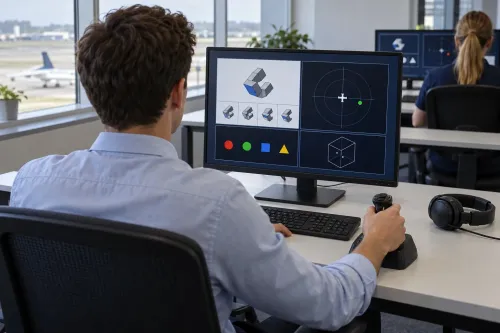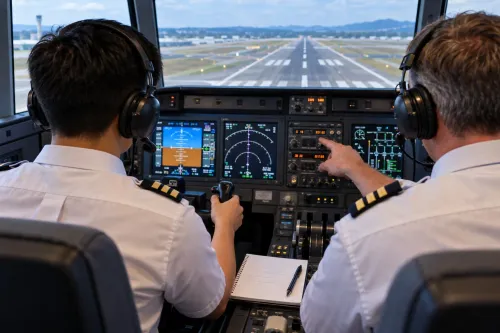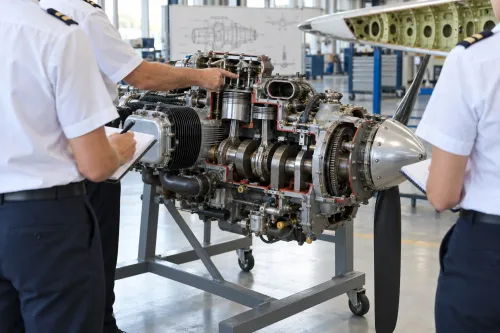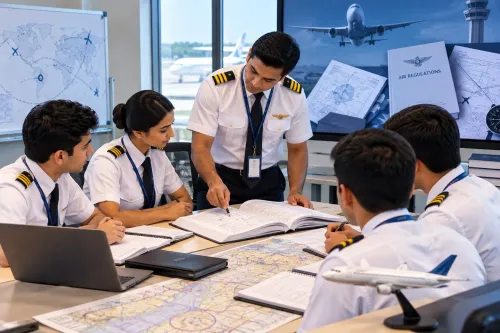
Pilot ground school turns classroom knowledge into decisions about navigation, weather, aircraft performance, regulations and safety. By the end, you should be able to identify the subjects in a complete programme, understand how each one supports flight training, and compare classroom, simulator and aircraft learning without confusing ground-school completion with a CPL.
Key takeaways
- Build mathematics, physics and aviation vocabulary before CPL subjects.
- Check 10+2 Physics and Mathematics eligibility for the DGCA CPL route.
- Connect weather, performance and flight planning lessons to aircraft decisions.
- Compare classroom, simulator and aircraft training before choosing a programme.
What Students Learn Before the Main CPL Subjects
Before the main CPL subjects, students build the mathematics, physics and aviation vocabulary needed to understand aircraft performance, weather and flight planning. This foundation also clarifies DGCA CPL eligibility: applicants normally need 10+2 Physics and Mathematics, while the licence is issued only after the required age, medical, examinations, flight experience and skill test.
A useful pilot ground school curriculum follows this sequence:
- Confirm entry requirements and study gaps, especially algebra, unit conversion, pressure, temperature and basic mechanics.
- Apply trigonometry for pilots to triangles, bearings, wind components, distance, time, heading and groundspeed.
- Learn aviation references and measurements, including nautical miles, knots, feet, degrees, UTC, magnetic variation and pressure altitude.
- Study the aircraft’s basic parts and controls before examining engines, electrical systems, instruments, limitations and performance charts.
- Build weather knowledge from pressure systems and temperature effects to cloud, visibility, wind and hazardous conditions.
- Introduce rules and procedures after students understand the aircraft and the airspace it uses.
This order prevents isolated memorisation. A student who understands vectors can follow navigation calculations; one who understands pressure and temperature can see why density altitude changes take-off performance. Meteorology then becomes a decision tool: reading a METAR or TAF and recognising thunderstorms, icing, turbulence, wind shear or reduced visibility before a flight.
Medical certification is separate from classroom instruction, and passing a school test does not equal passing a DGCA examination.
The Subject-by-Subject Map of Pilot Ground School
The four core DGCA theory areas turn into different cockpit decisions: legality, route, weather and aircraft capability.
| Subject | Principles and calculations | Procedures and practical use |
|---|---|---|
| Air Regulations | Right of way, airspace classes, licensing, aircraft documents, flight plans, clearances and operational responsibilities. | Decide whether a route and departure are legal, identify required communication, and apply circuit, separation and emergency rules. |
| Air Navigation | Charts, coordinates, magnetic variation, wind triangle, headings, tracks, groundspeed, ETA, fuel planning and dead reckoning. | Prepare a route, calculate heading and groundspeed, revise ETA, and check whether fuel reserves remain adequate. |
| Aviation Meteorology | Pressure and temperature effects, stability, fronts, cloud, visibility, wind, icing, turbulence, thunderstorms and wind shear. | Decode METAR and TAF reports, compare forecast conditions with aircraft limits, and make a go/no-go or diversion decision. |
| Aircraft and Engines Technical General | Aerodynamics, flight controls, piston-engine operation, fuel, electrical, hydraulic and pitot-static systems, performance and limitations. | Read the POH, calculate take-off and landing performance, respect operating limits, and select the correct response to an engine or instrument abnormality. |
Radio Telephony is normally a separately administered certification requirement, not another name for Air Regulations. A complete programme may also teach Human Performance and limitations, aviation medicine and flight-planning practice; confirm whether these are examination preparation, classroom support or separate courses. Internal tests measure progress, but only the DGCA examination establishes a theory pass.
How Ground-School Knowledge Is Used in Flight Training
A calculated route is only useful if you can keep it safe as conditions change. Ground-school theory turns into cockpit decisions: update your position, compare actual fuel with the plan, check weather and airspace information, and divert before a small discrepancy becomes an emergency.
Students practise heading and groundspeed calculation with wind, track, drift, distance and estimated-time data. They then use those results to choose a heading, predict arrival time and confirm whether fuel reserves remain adequate. A few minutes of uncorrected drift can place the aircraft outside controlled-airspace limits or leave less fuel than planned.
| Knowledge area | Cockpit decision | Material to read |
|---|---|---|
| Navigation | Confirm position, track, time and fuel | Aeronautical charts, flight plan and navigation log |
| Meteorology | Continue, delay, divert or avoid a hazard | METAR and TAF interpretation, weather charts and radar information |
| Airspace and procedures | Select a legal route and comply with restrictions | NOTAMs, airfield diagrams and operating procedures |
| Aircraft performance | Decide whether runway, load and weather permit take-off | POH and AFM performance tables, limitations and checklists |
| Aircraft records | Identify defects and confirm aircraft status | Technical log, journey log and defect entries |
The POH and AFM are not reference books to open after a problem occurs. Students learn to find operating limitations, take-off distance, landing distance, fuel data, engine procedures and weight-and-balance limits before flight.
Meteorology also supports go/no-go judgment. Thunderstorms, icing, turbulence, wind shear and poor visibility demand a decision, not merely a correct definition in an examination.
What Happens in Class, the Simulator and the Aircraft
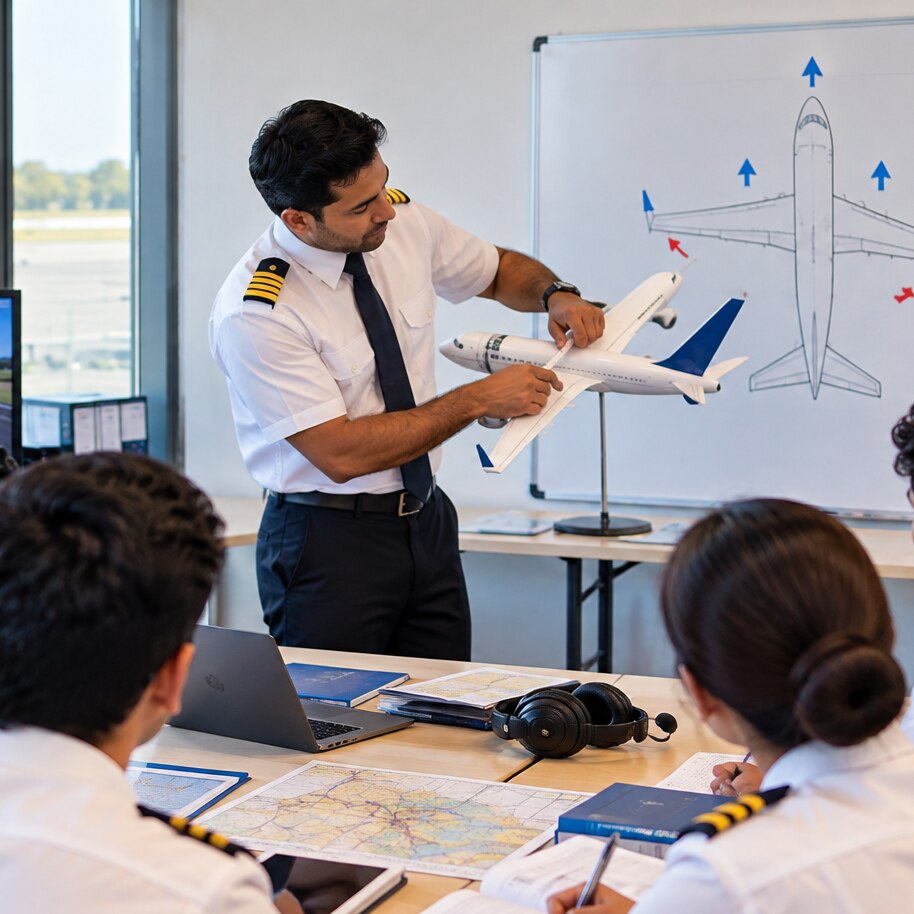
Classroom work connects rules and calculations to cockpit decisions. Ground school teaching methods include instructor-led explanation, worked problems and scenario discussion; question-bank practice then tests recall without replacing understanding. A good lesson asks whether fuel reserves remain legal, a runway performance figure is adequate, or a weather route is acceptable.
Flight simulator training rehearses procedures that are difficult, expensive or unsafe to practise repeatedly in an aircraft. You work through instrument failures, engine abnormalities, checklist actions, radio calls and go/no-go decisions, then review the result during a structured debrief.
Aircraft-and-engine lessons teach safe operation and monitoring, not aircraft maintenance. You learn to recognise abnormal indications, apply limitations and checklists, and decide when an aircraft is unserviceable or a flight must be discontinued.
In the aircraft, the instructor demonstrates how classroom knowledge appears in real handling: pre-flight checks, engine operation, taxiing, take-offs, circuits and landings. You then practise under supervision, where wind, workload, traffic and aircraft response cannot be paused like a simulator scenario.
Expect more than attendance. Plan for class preparation, question-bank revision, simulator briefings and debriefings, flight preparation, logbook work and post-flight study. Ground-school completion alone does not grant a CPL; prescribed medical fitness, DGCA examinations, flight experience and a practical skill test remain separate requirements.
How to Judge a Complete Programme and Its Limits
A complete programme shows exactly what prepares you for a DGCA examination, what supports flight training, and what remains outside ground school. Use this check before enrolling:
1. Match the syllabus to named examination areas: Air Regulations, Air Navigation, Aviation Meteorology, and Aircraft and Engines (Technical General). Look for worked calculations, METAR and TAF interpretation, aircraft limitations, performance data, and operational procedures—not slide-based topic names alone.
2. Check the assessment trail. Internal progress tests and mock examinations are useful only when they expose weak subjects; a school attendance certificate is not a DGCA theory pass. Ask how the programme tracks results and explains the separate DGCA examination process.
3. Confirm the related requirements in writing. Radio Telephony should cover standard phraseology, clearances, readbacks, callsigns, frequency use, emergencies, and inability-to-comply reports. The RTR(A) is administered by the Department of Telecommunications, so it is not automatically included in a DGCA ground-school certificate.
4. Look for Human Performance and limitations, aviation medicine, flight planning, and briefing practice. These subjects help you recognise fatigue, workload, spatial disorientation, weather hazards, and medical obligations before they become cockpit problems.
5. Test the programme’s limits. It cannot replace a prescribed medical assessment, 10+2 Physics and Mathematics, flight-experience requirements, DGCA examinations, or the practical skill test. Ask SKYJET PILOT TRAINING ACADEMY which items it teaches, which it coordinates, and which you must complete elsewhere.
A strong course connects classroom knowledge to aircraft and simulator decisions, but it does not issue a Commercial Pilot Licence by itself.
Related products
 | DGCA - Ground School Technical General DGCA CPL Technical General: Complete Guide to Aircraft Systems & Aerodynamics Technical General is one of the most important and conceptually... |
 | DGCA - Ground School Aviation Meteorology Classes Aviation Meteorology Classes for DGCA CPL – Complete Training Guide At Skyjet Pilot Training Academy, Aviation Meteorology is not just a subject—it... |
Frequently asked questions
What do students learn before the main CPL subjects?
Students build mathematics, physics and aviation vocabulary to understand aircraft performance, weather and flight planning.
Which subjects are covered in pilot ground school?
The programme maps the main CPL subjects and explains how each supports DGCA examinations and flight training.
How is ground-school knowledge used during flight training?
Students apply lessons on aircraft performance, weather and flight planning when preparing for and conducting flights.
What should you assess when comparing a pilot ground-school programme?
Check how the programme connects classroom teaching with simulator and aircraft training, and understand the limits of ground school alone.
Related products
 | DGCA Approved Flying School Pilot Training in Indian Flying school (DGCA CPL) While training abroad offers speed, pursuing a Commercial Pilot License (CPL) through an Indian flying club or Flight Training Organisation (FTO)... |
 | DGCA Approved Flying School CPL Training in South Africa South Africa, a leading aviation hub and an ICAO contracting state, is one of the most practical and cost-effective destinations for Indian students... |