
A cadet assessment is an airline-style selection process, not a shortened CPL flight test or a routine admission conversation. You will leave prepared to recognise each stage, manage timed aptitude exercises, communicate safely under pressure and check the medical and document requirements before assessment day.
Key takeaways
- Expect aptitude, coordination, multitasking, English and behavioural tests.
- Practise timed reasoning, mental arithmetic, memory and spatial-awareness exercises.
- Bring accurate medical documents and explain uncertainty instead of guessing.
- Assessors value safety-minded judgement, clear communication and coachability.
What a Cadet Assessment Measures—and What It Does Not
A cadet pilot assessment measures whether you are trainable and suitable for a structured airline pathway, not whether you already fly like a licensed pilot. It can test numerical and verbal reasoning, memory, spatial awareness, multitasking, hand–eye coordination, English communication, behavioural tendencies and interview judgement.
The exact tests and pass marks come from the airline or training provider’s airline selection standards; DGCA does not prescribe one universal cadet aptitude test.
| Process | What it measures | What passing means |
|---|---|---|
| Cadet pilot assessment | Aptitude, concentration, teamwork, communication and trainability | You meet that provider’s selection threshold; you do not hold a licence or receive a job guarantee |
| DGCA written examination | Formal knowledge in Air Regulations, Air Navigation, Aviation Meteorology and aircraft technical subjects | You receive credit for the relevant DGCA paper; aptitude-test marks do not transfer |
| Flight-school admission interview | Motivation, education, finances, communication and readiness for training | The school may admit you; it does not confirm airline selection or DGCA eligibility |
A DGCA written examination is a licensing hurdle. You still need the required DGCA medical fitness, approved training, flight experience, skill tests and records for an Indian CPL; a cadet pass replaces none of them.
An ab-initio applicant may have no licence or limited flying experience because the assessment targets trainability rather than polished circuit technique.
A flight-school admission interview usually decides whether the school wants to enrol you. A cadet assessment asks whether your abilities and behaviours match a particular airline pathway, including its teamwork, workload and safety expectations.
Medical-document review can also expose issues with vision, colour perception, hearing or cardiovascular health, so ordinary day-to-day fitness does not prove professional aviation medical fitness.
The Usual Assessment-Day Sequence
Arrive early with the identification and documents named in your invitation. The assessment day usually moves from administrative checks to timed testing, interactive exercises and interviews, with short breaks between stages. The provider’s schedule controls the exact order.
1. Register at the stated venue or online portal. Staff record your attendance, check your application details and explain where to wait.
2. Complete identity verification using the specified government-issued ID. Staff may compare your photograph, application data and supporting documents; a mismatch can stop you before testing begins.
3. Attend the briefing. Listen for time limits, permitted equipment, scoring rules, toilet or break procedures and instructions for reporting technical problems. Ask questions before the exercise starts.
4. Take written or computer-based aptitude tests covering areas such as numerical reasoning, memory, spatial awareness, concentration and multitasking. A difficult question can consume marks, so follow the stated navigation and timing rules.
5. Use the scheduled break to reset rather than discuss answers. Some providers also complete English communication, psychometric or technical-knowledge checks during this testing block.
6. Complete the group assessment, where assessors observe listening, teamwork, spoken English, judgement and leadership while you solve a defined problem with other candidates.
7. Attend an individual interview, simulator exercise or medical-document review if listed in your invitation. The day ends with final instructions about results, next stages, outstanding documents and contact procedures. Selection does not replace DGCA examinations, medical fitness requirements or later flight training.
The Tests, Exercises and Behaviours Assessors Watch
You may complete these tasks, each aimed at a different cockpit demand:
- Numerical reasoning: solve timed calculations and data questions. It reveals accuracy, mental arithmetic and whether you manage time instead of getting trapped by one problem.
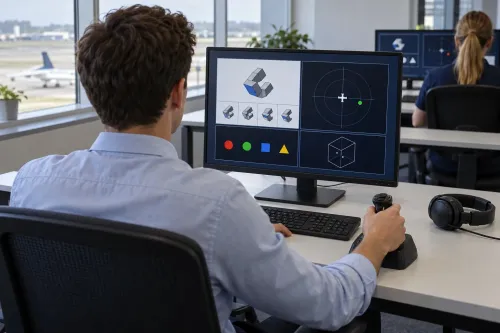
- Spatial awareness: interpret headings, diagrams or three-dimensional rotations. It tests how easily you build and update a mental picture.
- Memory: recall symbols, instructions or changing information. It shows whether you can retain details while new demands compete for attention.
- Multitasking test: track a target while responding to visual or audio signals. It reveals attention control, reaction speed and workload management.
- Psychomotor coordination: use unfamiliar controls to follow a moving cue. Assessors look for steady improvement and controlled corrections, not instant flying skill.
- Psychometric testing: answer personality, judgement and behavioural questions. Consistent answers help assess reliability, self-awareness and responses to pressure.
- English and communication checks: explain information, listen accurately and speak clearly. These skills matter when misunderstandings can affect safety.
- Group exercise or interview: solve a problem with others and discuss your decisions. Assessors watch listening, cooperation, assertiveness and whether you follow a safe procedure when convenience conflicts with it.
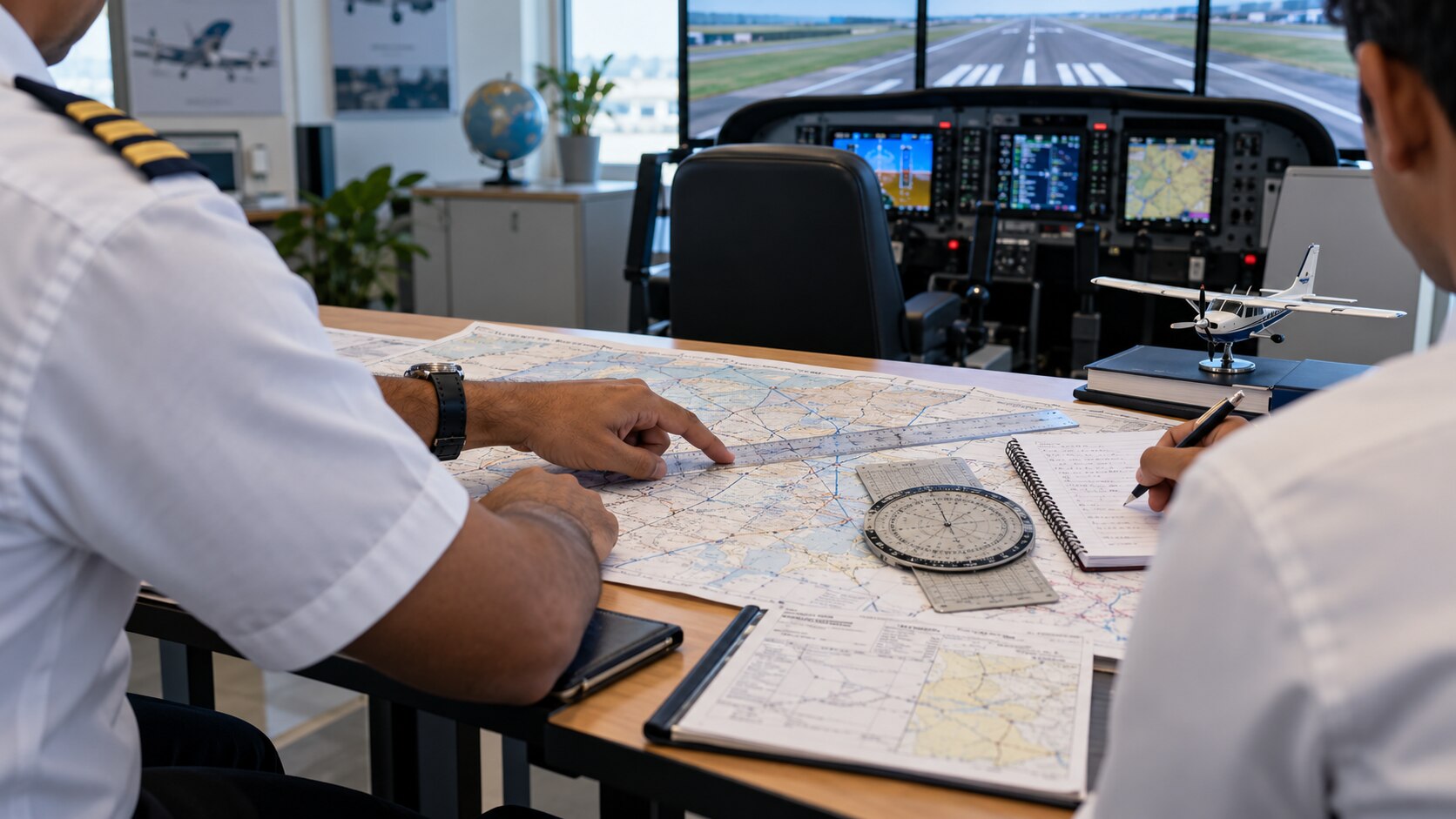
- Simulator assessment: manage a basic flight scenario or instrument task. It tests how you learn, prioritise and respond to feedback.
A poor first few minutes does not settle the result. Assessors value a controlled recovery, because professional training requires you to recognise errors, accept correction and keep working accurately under pressure. The exact exercises and pass marks belong to the airline or training provider, not to one universal DGCA test.
How to Prepare Without Chasing Leaked Question Banks
Use representative tasks, not leaked question banks. Effective cadet aptitude test preparation builds transferable skills because each airline or training provider sets its own format, scoring rules and pass marks.
1. Take timed practice tests under the stated conditions. Record accuracy, completion time and questions that consumed too much time. Learn to move on when one difficult item threatens several easier marks.
2. Drill mental arithmetic without a calculator. Practise percentages, fractions, ratios, unit conversions and speed–distance–time problems until you can work them cleanly under pressure.
3. Train spatial awareness and coordination separately. Use mental-rotation exercises, pattern matching and tracking tasks that require accurate mouse or joystick movements. Measure errors as well as reaction speed; fast, uncontrolled responses do not demonstrate useful control.
4. Strengthen concentration with short attention exercises. Search for changing symbols, follow multiple moving items or perform two simple tasks together, then increase duration only when your accuracy remains stable.
5. Review every error by category: arithmetic, instructions, memory, rushing, visual misread or loss of focus. Fix the category causing marks to disappear instead of repeating full papers without analysis.
Do not alter the scoring method or use equipment that the assessment prohibits. Sleep normally, eat a familiar meal, drink enough water and read every instruction before starting.
A practice score is valuable only when it reveals a weakness you can correct; memorising an exposed question set is fragile when the provider changes the numbers, layout or task entirely.
Interviews, Medical Documents and Handling Uncertainty
A judgement answer should show a safe process, not a heroic personality. In pilot interview questions, explain how you would establish the facts, follow the procedure, communicate the risk, and escalate when your authority or information is insufficient. Do not hide an error to appear confident; explain what you would do after discovering it.
Use this sequence before submitting an application:
- Check the programme’s document list against your passport, identity proof, education certificates, photographs and any required forms. Bring original documents and readable copies if the instructions request both.
- Arrange a DGCA Class 1 medical early. Ordinary fitness does not prove professional aviation fitness, so ask the medical examiner about vision, colour perception, hearing, cardiovascular findings, medication and previous conditions.
- Prepare every relevant medical record for the medical-document review, including earlier aviation reports, prescriptions, corrective-lens details and specialist letters. Never omit a diagnosis because it seems unrelated; inconsistent records can create a larger problem than the condition itself.
- Treat the English communication assessment as an operational check. Listen fully, answer directly, state uncertainty clearly, ask for clarification and describe safety concerns without vague phrases.
- Identify the weak point before seeking coaching. Timed reasoning, spoken English, interview evidence, coordination under workload and medical eligibility require different remedies.
If you need help separating a DGCA ground-knowledge gap from an assessment weakness, Skyjet Pilot Training Academy can help you decide which preparation is relevant before you spend money on an application or retest. A failed attempt calls for an error diagnosis first; check the programme’s waiting period before booking again.
Frequently asked questions
What does a cadet pilot assessment measure?
It measures trainability and suitability through reasoning, memory, spatial awareness, multitasking, coordination, English communication, behaviour and interview judgement.
What happens during a cadet pilot assessment day?
The day usually moves through registration, instructions, aptitude tests, coordination or multitasking exercises, interviews and document checks.
How should I prepare for cadet pilot assessment tests?
Practise timed numerical and verbal reasoning, mental arithmetic, memory, spatial-awareness and hand–eye coordination exercises without relying on leaked question banks.
What should I do if I am uncertain during the interview or medical-document check?
Answer honestly, explain what you know, ask for clarification when needed and bring complete, accurate medical documents.